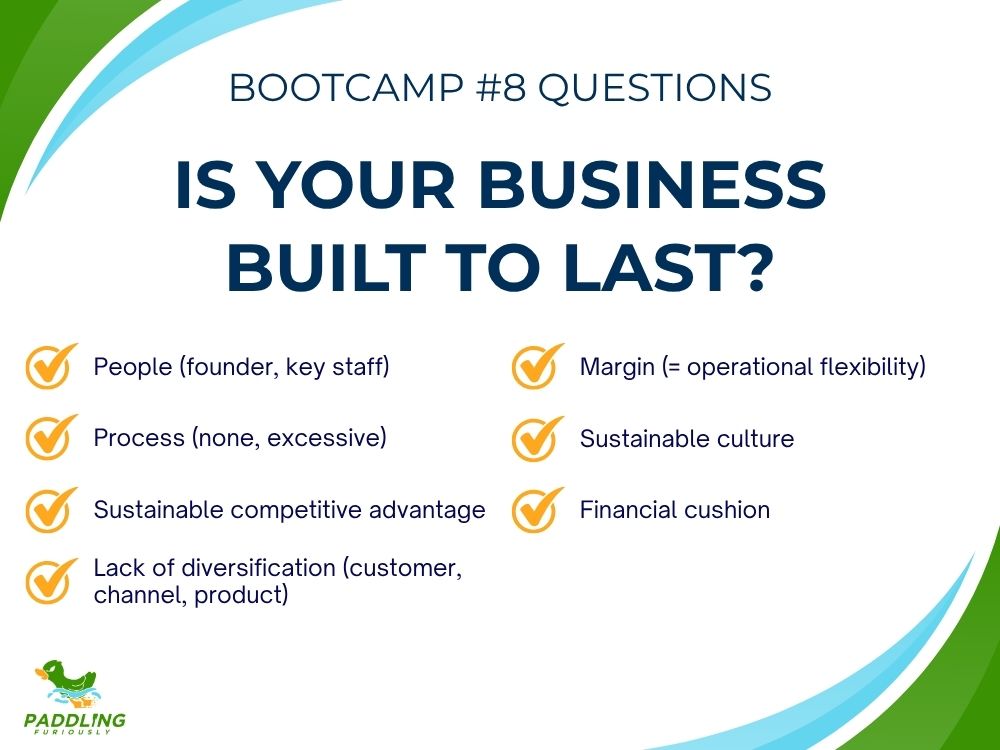
How solid is your base?
- What would be the first thing to stall or fail if you disappeared with no notice?
- How many decisions in your business require you personally? How many should?
- Where are you relying on a single person’s (including your own) institutional knowledge?
Are you building processes or just working harder?
- Which critical activities exist only in someone’s head?
- Are your most important processes documented well enough for someone else to follow?
- Where are mistakes, delays, or improvisational responses costing you time or money?
- What does your business do consistently well because you have a good process—not because you have good people working unusually hard?
- How often do you make structural changes rather than just working harder?
How strong is your competitive advantage?
- If your biggest competitor cut its prices by 20%, why would customers still choose you?
- Is your advantage structural, or does it depend on continued effort?
- What took you years to build and can’t be recreated quickly?
- Are you becoming more differentiated as you grow—or more interchangeable?
- What are you doing today that will make the business harder to compete with three years from now?
Do you have a financial cushion?
- How long could your business survive a 30% revenue drop? What comparatively easy operating decisions could you make to counter? When would you start panicking?
- Do you have a cash reserve? How solid is it? What / how long would it cover?
- Does growth improve your economics—or require you to spend more and more to support it?
Where are your major exposures?
- What percentage of revenue comes from your single largest customer? The five largest? Ten?
- How dependent are you on a single supplier, platform, or partner you don’t control?
- Is there one employee whose departure would seriously damage the business? Do they know that?
- Where does concentration create unacceptable risk—and where is concentration actually a strategic choice?
Have you built a foundational culture?
- Are you creating a culture, or is it just evolving as you grow?
- Which behaviors are rewarded in your company? Which are tolerated that you wouldn’t want five years from now?
- Are good people attracted to the business and culture, or must you close each new hire personally?
- Do people understand what decisions they can make without asking permission?
- What would your employees say your company values if you weren’t in the room?
Are you ready to face the future?
- What would break first if your market or industry changed significantly in the next year? What type of change would be most harmful?
- How and how quickly would you notice a major shift or risk? How quickly could you adapt?
- What’s one assumption your entire business currently depends on — and how confident are you it will still be true in three years?
- Are you building flexibility into your business—or locking yourself into today’s decisions?
- If you were starting today with what you now know, what would you build differently to make the business more durable?
- Does growth make your business more resilient or less so? Which (growth or resilience) are you optimizing for?
Want more information on growing your business
Watch the video or read the full post to learn more about how to make your business more resilient, so you’re better prepared to grow
Key aspects of a resilient business include:
- Strategic pricing that helps build and strengthen the business (post and key questions)
- A customer strategy that identifies, builds on and supports your best clients (post and key questions)