From founder to builder
As we’ve come to the end of our Business Bootcamp series, we want to highlight certain recurring themes across the modules – and from what we’ve heard from all of you.
Unsurprisingly, perhaps the most important is: it all comes down to you.
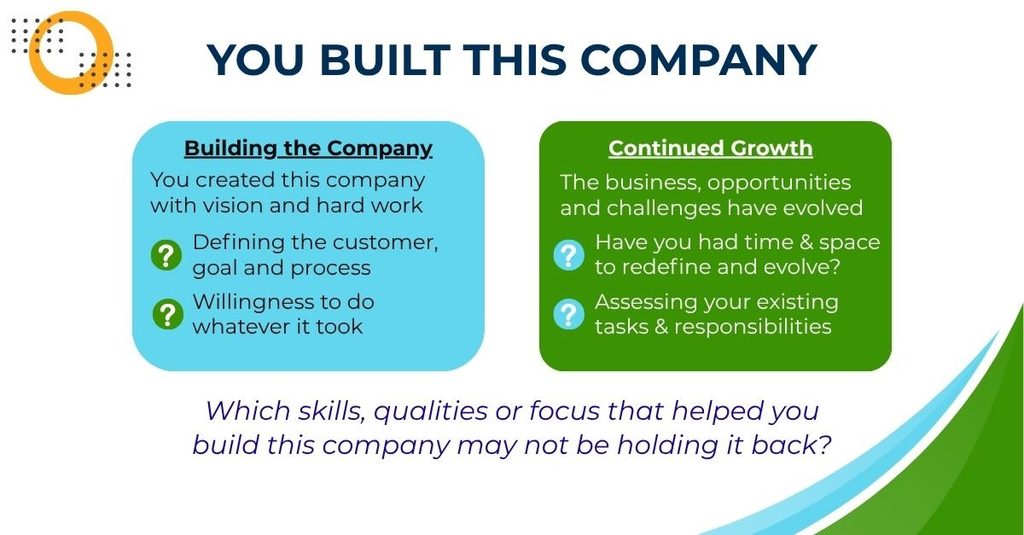
You started this company. You built it into what it is today. You’re the one with the vision to take it farther.
But just as you had to learn a lot to get here, there may be further transformation ahead.
Starting a company requires vision, for sure, but day-to-day, you’ve learned to rely on scrappiness, intuition, responsiveness and a willingness to do whatever it takes.
You’ll still need those qualities. But you need to shift how you focus and apply them.
- The burden of answering every question, solving everyone’s problems, responding to every issue has grown along with your company and team – and it’s taking time that’s probably better spent reviewing strategy, strengthening your staff and managing growth
- In the early stages of growth, most founders delegate tasks to new hires while retaining responsibility. This probably needs to change.
- Even the tasks you think of as “yours” may warrant review: how can you provide insight and expertise, while offloading operational tasks so that you have more time to lead?
Which skills, qualities or focus that helped you build this company may not be holding it back?
Time is your most valuable resource
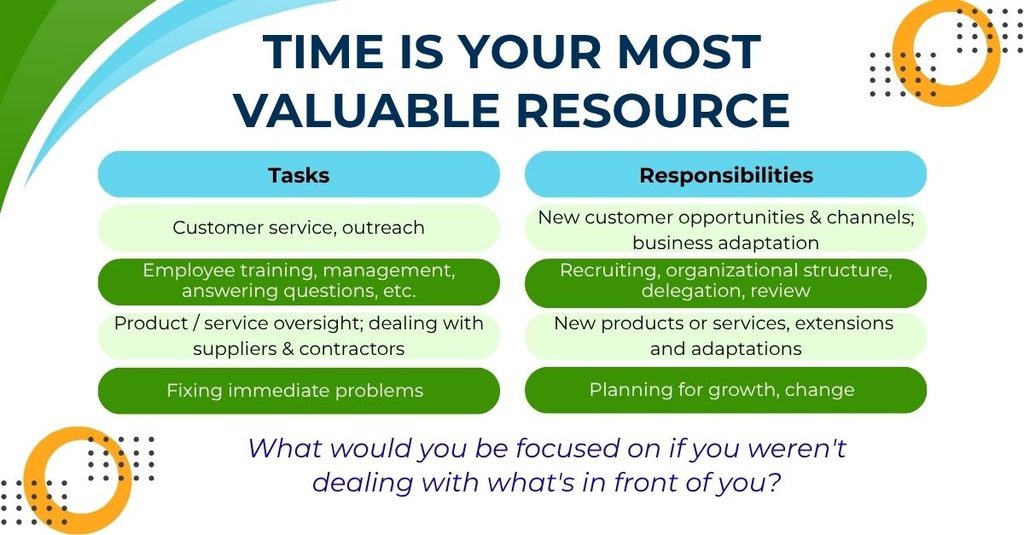
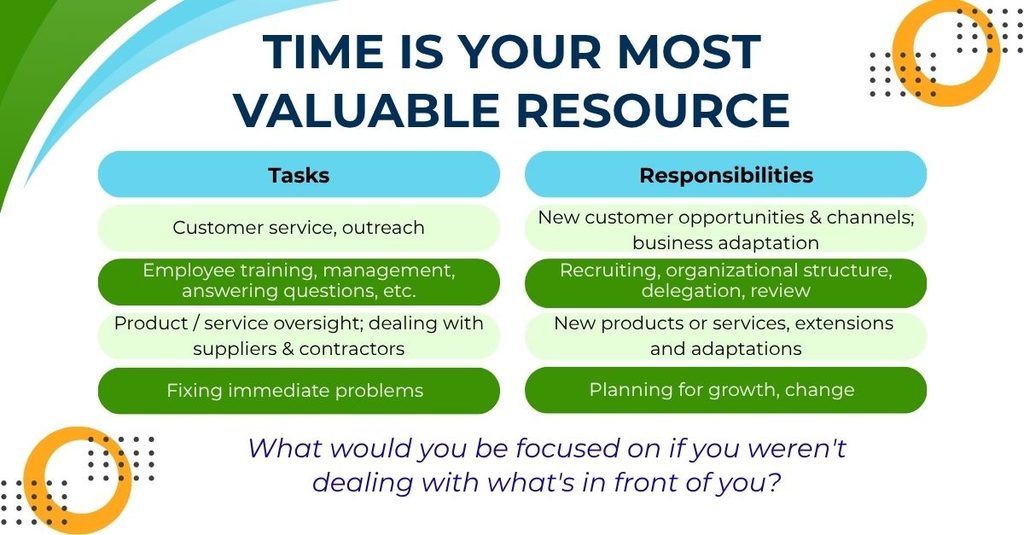
You love this business, cherish your customers, value your staff. You want to be there for and with them. But that means a lot of time spent on:
- Customer service and support
- Employee training and management
- Answering questions, responding to inquiries
- Day-to-day operational issues around products and services, suppliers, partners, channels
All of these things are important. But are they the best use of your time?
Think of how you might otherwise spend that time:
- Developing new customer verticals, channels and opportunities
- Brainstorming new products or services, line extensions or other adaptations to broaden your appeal
- Strengthening your organization and supporting managers to take on more responsibility
- Making sure processes and efficiency continue to improve, strengthening your base for growth
- Strategizing and laying the foundation for continued growth
What would you be focused on if you weren’t dealing with what’s in front of you?
Where are you most needed
Let’s face it, running from crisis to crisis, answering one question while drafting a response to another may be exhausting, but it’s also exhilarating. You feel needed. You can see the impact you’re having.
Some of that other stuff? The planning, organization, delegation? It’s hard to calibrate what you’ve accomplished.
Besides, this is your business. You need to run it.
Or do you? Do you want to run it? Or grow it?
To keep developing the business, do you need to be in charge of or involved with every aspect? At this point, probably not.
What the business needs is your experience, insight and expertise. You can provide those without doing every task yourself.
So don’t ditch everything you’re doing. Look for places to delegate, offload, limit your involvement. Examine your most time-consuming recurring tasks:
- Is this something only you can do?
- If it requires your judgement or input; is there a way to provide that input and let others take it from there, reducing your time commitment?
- If there’s no one currently who could take on part of the workload, what could eventually be done by someone else, if you provided them with the right training or systems and built trust?
- If you’re able to reduce time spent on these tasks, what could you be doing instead? Which is more valuable?
Are you running the company or building it?
Your shifting role: new rules of “engagement”
Recognizing how much more you might add to the business if you could offload some tasks is only the beginning; doing so is harder.
Until now, your role has been to get things started, keep things moving. You were out there, in the trenches, every day. And it wasn’t just for show. That’s how you really got to know customers, learned what they wanted. You trained and watched staff, saw what worked, what didn’t.
Most of your best ideas arose this way. How will you see the path forward if you’re not out there?
First of all, finding time for strategy and management doesn’t mean stepping away entirely. Even if you wanted to (and you probably don’t), you can’t just retire to your ivory tower and think big, strategic thoughts.
So you’ll still spend plenty of time with staff, customers, suppliers, partners and everyone else who matters to your business. You’ll know what’s going on, where there are problems, be able to spot opportunities.
In fact, a little distance might actually help. With a little time, less mired in day-to-day tasks, you might see things more strategically, ask a few extra questions, probe a bit deeper. You may be able to spend less time and learn more.
If you’re working day-to-day, you think day-to-day. You solve the problems in front of you, worry about what needs to happen tomorrow.
Those things will always be important, but there are others who can do them, or at least help. As less of your time is consumed with routine tasks, you may be better able to see patterns, spot opportunities:
- Where is there excess complexity, redundancy? Where could product offerings, staff time, marketing efforts be better spent?
- Where are processes or training incomplete, leading to uncertainty and inconsistency?
- Once you’re doing less busy work and thinking more strategically, you may be able to help the entire organization evolve as well
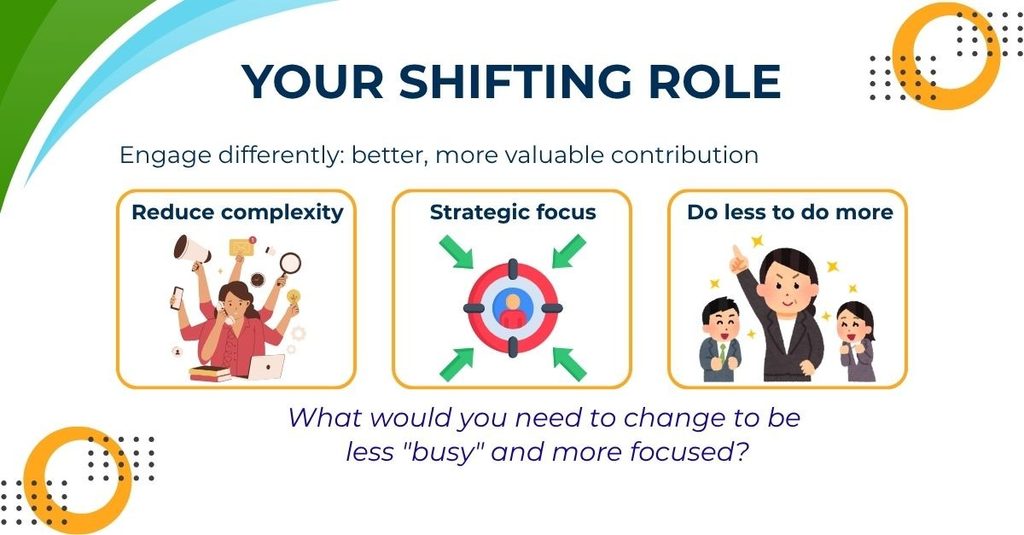
What would you need to change to be less “busy” and more focused?
Get out of the way of future growth
Thus far, your company’s growth has depended on you. It still does. But what the business needs from you is evolving, so you may need to adjust how you spend your time, which tasks you’re involved in, how you manage and delegate.
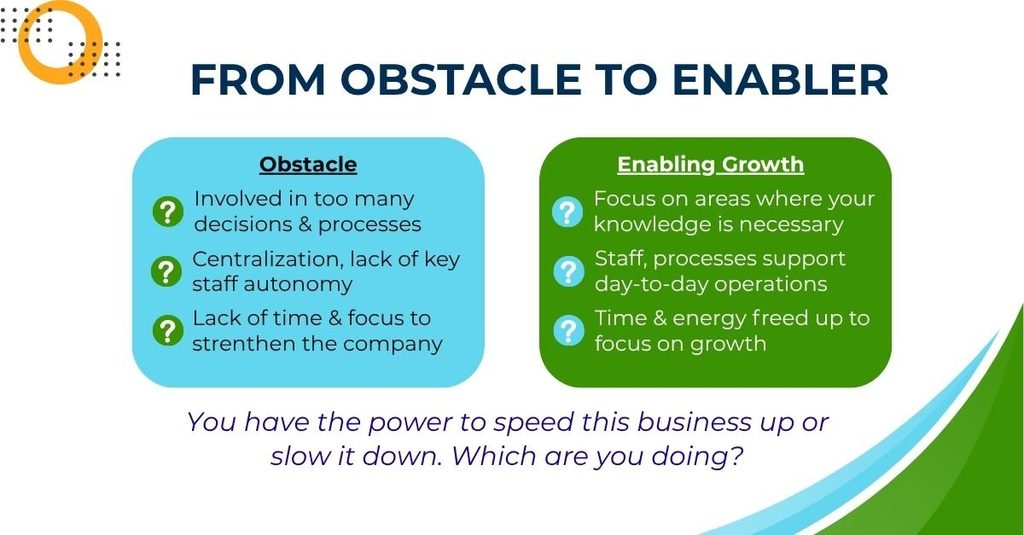
Many of the attributes that got you this far – your all-encompassing knowledge of the business, the fact that you were involved in everything and could make any decision, your ability to create a product, system or process to match any need – may now be the things slowing your company down.
To get back on the path to growth, you need to:
- Focus on areas where your knowledge is necessary
- Limit your contribution to strategy, oversight, sharing of expertise; let others execute and manage, as much as possible
- Free up time – real time! – to analyze the business, think about where you ought to be headed and plot a course to get there
Where do you want the company to be in three years? What does your role need to look like to make that happen? What’s one thing you could stop doing right now to free up time for the things only you can do?
You have the power to speed this business up or slow it down. Which are you doing?
Want more information on growing your business?
Watch the video to learn more about how to develop, review and maintain a marketing strategy that works for your business
Access our full list of questions to help you determine where and how to focus your strategic efforts
Time management is crucial to giving you the time to evolve from founder to leader. Learn more at Bootcamp #1: Finding — and managing — your time and check out the full list of questions here
You’ll also need to build a team you can truly rely on and delegate to. Learn more at Bootcamp #9: Do you have the team you need? and access the full list of questions here.
Access the full list of business bootcamp topics and questions here