Pricing works hard
“Are my prices too high? Too low? For too many business owners, that’s the extent of their pricing considerations.
It’s an obvious question, but often not the right one. Most businesses are better off focusing less on price, more on pricing: how they price, what they charge for, how is pricing presented to customers and what effect does it have on them.
Done right, pricing works hard for your business. It can influence:
- Who buys
- How quickly they buy
- Customer expectations, and thus satisfaction
- Your company’s growth, profitability and sustainability
Are you selling your products or services the way customers want to buy them?
Have you revisited your pricing strategy?
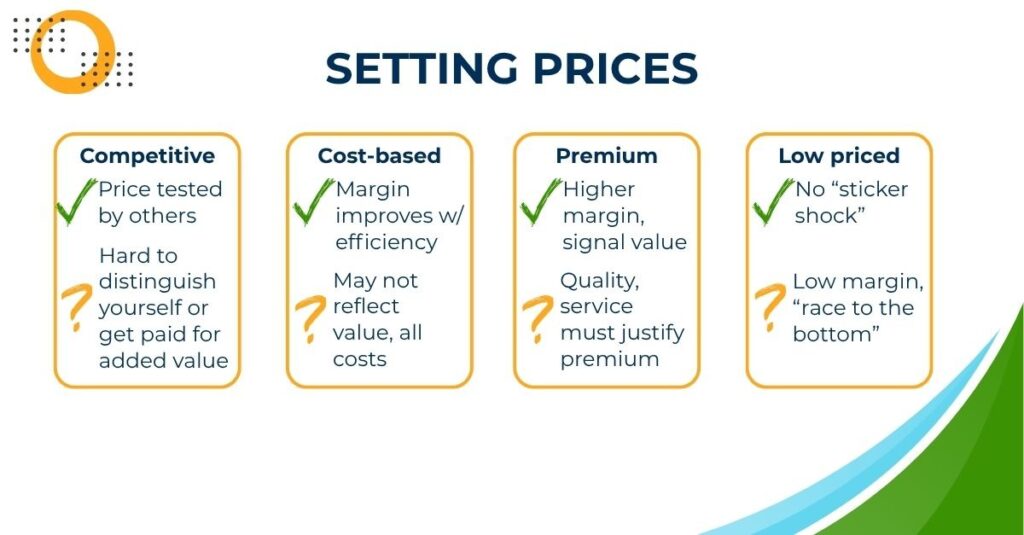
When setting prices initially, most business owners strive to be “fair”. They don’t want to underprice, but as a newcomer, are wary of charging too much. Popular strategies include:
- Competitive: new businesses aim for somewhere in the middle of competitors’ price ranges
- This can indicate that your quality is also mid-range. Is it?
- Does this price strategy reflect quality, value or other elements you’ve added since launch?
- Cost-based: by covering your direct costs, you insure a solid margin that should improve as you gain efficiencies
- However, this may not include often significant indirect costs, such as sales and marketing, support, etc.
- Costs may not reflect either relative quality (relative to competitors) or perceived quality (what customers care about)
- Premium: setting prices at the high end of competitors’ range to signal that yours is a higher quality product or service
- Needs to be supported by marketing, service provision, support and all aspects of the customer experience
- Is the quality you’re measuring something customers care about and will pay for?
- Low-priced: pricing at the low end of the range to make your product or service immediately attractive
- Any signal of, or ability to charge for, relative quality may get lost
- May tie you to low margins, “race to the bottom” as others drop prices
However you initially set prices, it’s worth revisiting them periodically to ensure that:
- Your prices still reflect the relative value you provide and the competitive positioning you seek
- Relative value reflects not only your inputs, but more importantly, the customer’s perception
Do current prices reflect the value you’ve added since you first set pricing?
Customers pay for what they value
Pricing should reflect value. The business owner may have an opinion regarding relative value, but it’s the customer’s view that counts.
- The business owner tends to focus on inputs: higher quality materials, a better manufacturing process, longer or more intense service provision, better training
- A customer may appreciate and even be willing to pay for these qualities – if they can perceive them! – but may also value:
- Convenience, speed
- Customization
- Certainty, consistency, reduced risk
- Overall transaction and support quality
Is there something a customer would pay more for (attention, speed, customization)? Do you offer it? Do you charge for it?
Different customers; different needs
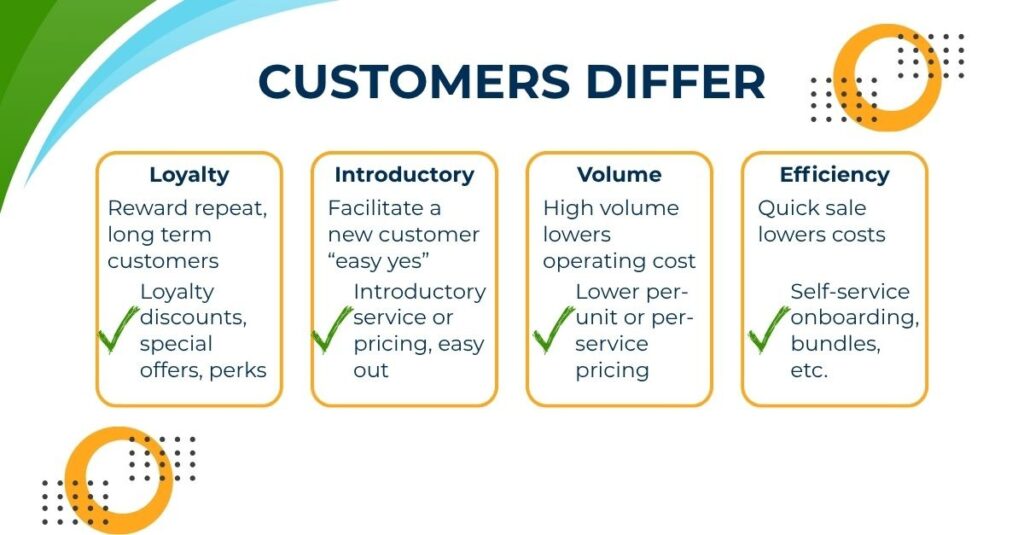
This isn’t one size fits all. Your business may have a target customer, but it no doubt serves many different types of customers. Each has different needs and objectives, which your pricing should reflect:
- Introductory: what slows or complicates the process of getting a new customer to make that first purchase?
- Loyalty: once you’ve gained a customer, how do you urge them to return?
- Volume: transaction size is an important factor in profitability. If someone’s buying, how do you get them to purchase more?
- Efficiency: A quick sale may net the same profits as a slow one, but it consumes far fewer resources. How can you encourage purchase efficiency?
Are you attracting the customers you want, or the ones your price point attracts
Cover your costs
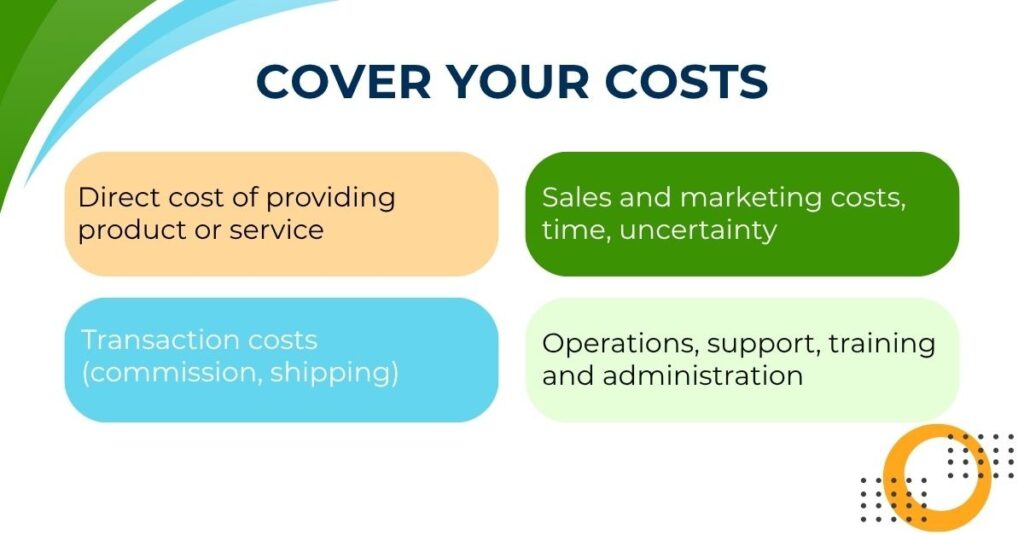
Another issue with pricing is that it’s typically focused on direct costs. How much does it cost to produce this item, to provide that service?
That’s a good starting point, but there are many other costs to consider:
- Sales and marketing costs: acquiring a customer takes time and costs money.
- A longer, costlier or more uncertain process costs more, because it increases the resources necessary to add a customer
- Pricing can assist by decreasing uncertainty or other friction that extends the time to close or by encouraging repeat purchases
- Transaction costs: Closing a sale may itself entail expense
- Shipping, delivery, commissions, revenue shares or other costs must be reflected in good pricing
- Seeking to maximize transaction value (service subscriptions, free delivery above a minimum value, etc.) can offset these costs and encourage larger transactions
- Support and administration: your costs don’t end when the sale is complete
- Operations, support and administration costs must be covered as well
- Clear pricing (bundles, tiers) can clarify what the customer is paying for, reducing support costs
Do your prices (and thus margins) reflect the full cost of selling or supporting your offerings?
“Friction” hurts your business
Time is money, so anything that takes time adds expense. This is particularly true in the sales process, because it’s not only consuming time and resources, it’s delaying the sales that will help offset these costs.
Friction can be reduced by:
- Help the customer buy how they want:
- If they want single products or one-off services, don’t overcomplicate things
- Offer bundles where customers prefer to buy products in combination or utilize a blend or series of services
- Link price to value: make sure bundled products or included services are things the customer values enough to pay for; why offer free delivery if most customers don’t use it?
- Reduce pre-sales time and uncertainty: bundles and tiers can help clarify and differentiate offerings, reducing pre-sale questions and the need for custom quotes
- Reduce administrative costs: customers have fewer post-sales questions and issues when they understand and value what they’re paying for
How many customers can understand your pricing and make a decision on their own?
What’s holding you back
Beyond pricing tactics, many young businesses are reluctant to raise prices. Or, if prices are at a competitive level, they’ll discount to “close” a sale.
As we’ve seen, price is rarely the sole impediment to a sale. Take a look at why you’re discounting. Clearer descriptions, tiers, bundles or other explanatory approaches may be what you need. And less discounting equals higher prices.
If you’re not discounting, but feel your pricing is low:
- What’s the story you tell yourself about why you can’t charge more?
- What’s stopping a customer from spending more with you? Are there add-ons you could offer, additional services you could provide?
- What’s the worst thing that would realistically happen if you raised prices 10%? Where would you get most or least push back?
Which are your highest margin products or services? Does your pricing encourage customers to choose these?
What pricing would you design today?
You set your pricing before you launched your business. You’ve learned a lot since then. And while you’ve probably updated your prices, have you rethought your pricing?
Give it a try:
- Who are your best customers
- What do they value
- Where are your costs, friction?
- What creates value for you? For the customer?
If you rebuilt your pricing structure from scratch today, what would it look like?
Want more information on growing your business
Watch the video to learn more about how pricing strategies can help your business
Access our full list of questions to help you determine how your business’s pricing strategy could benefit
Good pricing drives business growth; read more about what real growth looks like and how to improve it