Are you building for the future?
There are lots of reasons hiring is hard for a young business.
- It’s a big commitment, operationally and financially
- Attracting the right people to a still-evolving business can be challenging
- Defining the role, recruiting and training take time, which can be hard to find when you’re running a growing business
So most hiring, particularly in the early stages, tends to lag the business, straining to catch up. By the time you identify a need, find and onboard the right person and get them to where they’re really contributing, the business has often moved on. And you need to hire again.
That’s fine. It’s how most businesses grow. Frankly, there’s rarely an alternative. But as the business evolves, you’ll need to approach hiring proactively, not reactively, to drive growth and progress.
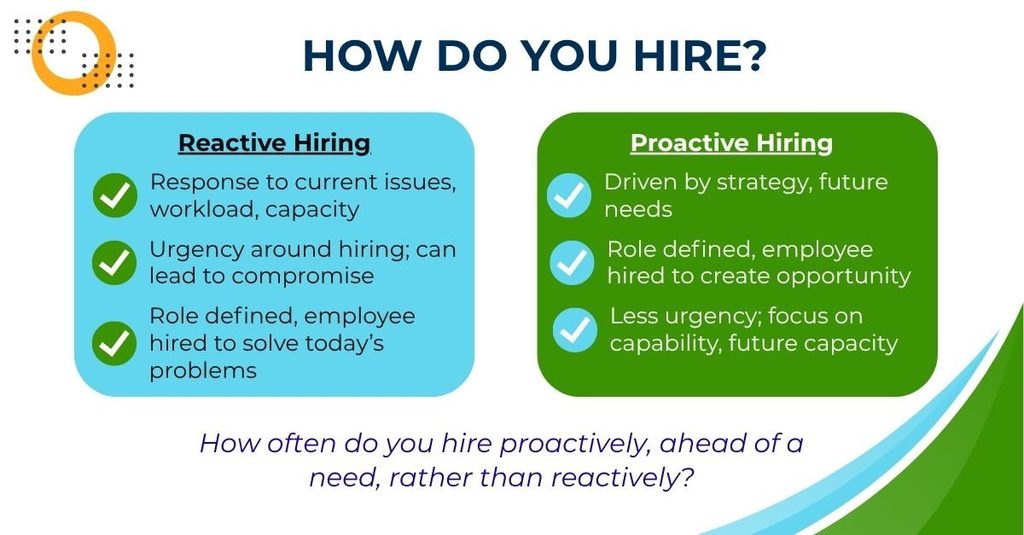
Hiring reactively can really slow your business growth:
- The urgency involved can lead you to compromise on quality
- As your business and team grow, you not only need to add to staff, you need to replace turnover. This can lead to confusion, inefficiency and, unfortunately, more turnover
- Catching up – let alone getting ahead – becomes progressively harder and riskier
- You end up adding to or replacing current skills, instead of supplementing with the skills and experience you need for your company’s next stage
What skills will the business need at twice its current size that it doesn’t have today?
Proactive hiring starts with existing staff
Creating the team you need doesn’t mean you have to replace your current staff. Rather, you want to start with a review:
- What are the current roles and are those still valid
- Who is performing well in their current role? Who may be ready to take on more responsibility? Who might need training or mentorship?
- Are the goals and responsibilities of those roles well defined?
- Where should current staff be upgraded or augmented?
- Where are there gaps that can not be addressed simply by adding to existing roles?
Identifying those gaps is the first step towards defining the team you need to grow:
- Should you be looking to create or evolve existing roles to something new? Are there current roles that may no longer be needed?
- Where are there capability gaps, roles or skills that are entirely missing?
- Beyond staffing and roles, what organizational structure will be best able to manage the team we’re building?
How would your team and roles differ if you were building your company from scratch today?
Identifying capability gaps
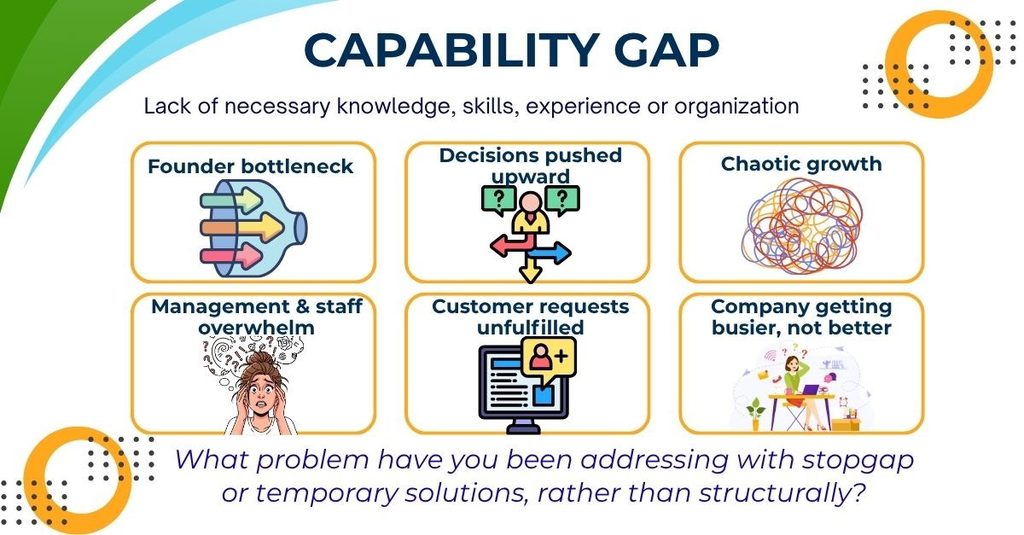
Capability gaps are the skills or experience that your company is missing entirely; they may be things you do occasionally, but can’t do consistently well, can’t do at the scale and quality required to grow, or have no ability to do at all.
Signs of a capability gap can include:
- Founder bottleneck: the same or similar issues and questions keep landing with the founder because staff lack the skills or expertise
- Decisions pushed upward: line staff are not sufficiently trained or empowered to meet customer or business needs, increasing strain on managers
- Chaotic growth: instead of becoming more efficient and scalable with growth, operations become more chaotic, decisions more reactive, quality more uneven
- Management and staff overwhelm: all of these factors make it challenging for the team to operate effectively, lowering morale and further impacting efficiency
- Customer requests unfulfilled: challenged at completing routine tasks, staff are unable to meet special requests, respond to customer questions or inquiries
- Company gets busier, not better: as discussed in Module 2: Are you growing, or just busy, it can be challenging to distinguish sustainable, scalable growth from an increase in activity. Capability gaps typically lead to more busyness, rather than sustainable growth
Delegate responsibility, not just tasks
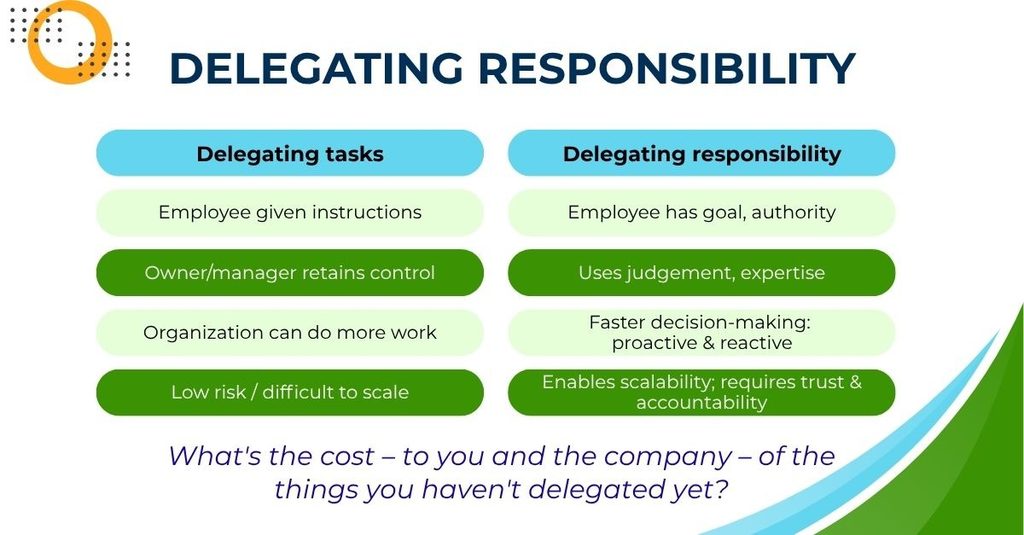
An efficient team is built on effective delegation. Too often, however, owners and managers delegate tasks, rather than responsibilities.
Delegating tasks is necessary and it’s often all that’s required with junior or part-time staff. When delegating tasks, the owner or manager specifies how the task is to be done, but retains control and decision making. This allows the company to do more with limited operational risk, but it’s difficult to scale.
Delegating responsibility is more involved and requires trust, training and accountability:
- The employee is responsible for achieving goals, rather than completing tasks and is given the authority to do so. (You can, of course, place some limits on that authority.)
- The owner or manager trusts that the employee will use their experience and expertise, their familiarity with the issue at hand and their judgement to address most operational issues.
- Delegating responsibility allows the company to be more flexible, responsive, and to solve problems or respond to opportunities more quickly
- This creates a platform for scalable, sustainable growth
What’s the cost – to you and the company – of the things you haven’t delegated yet?
Let others own the outcome
When staff are assigned tasks rather than responsibilities, they focus on the assignment, rather than company goals. This may make it harder to recognize or respond to problems. And since most decisions need to be funneled up to a manager or the owner, lots of work ends up being done twice.
When staff members own the outcome, they’re able to recognize and respond to issues and can identify opportunities to innovate, all while lessening the burden on management. The organization as a whole can move faster and make better-informed decisions more quickly.
This allows the company to become more efficient as it grows, creating a platform for continued improvement and expansion.
Could you name the person who owns the outcome for each major function in your business?
Hire with a focus on the future
Building for the future, creating a team whom you trust sufficiently to be able to delegate outcomes doesn’t mean you have to replace your existing team. Many of your current staff may be ready to step into roles of greater responsibility in the revamped organization chart you’re looking to evolve to – or can be prepared to do so with some training or mentorship.
Even if you don’t need to replace anyone (and that, sadly, is fairly unusual), you’ll still need to hire to support growth and add the capabilities your company needs going forward.
Proactive hiring:
- Focuses less on current needs and more on where the company is going and the skills you’ll need to get there.
- Because you’re not struggling to catch up with current workload, there’s less urgency; you can be more deliberate, take time to find and onboard the right candidate
- A proactively hired employee is not just someone who can complete tasks; they should be able to help identify and create opportunities
How often do you hire proactively, ahead of a need, rather than reactively?
Reward what’s important
Hiring isn’t the only thing that has to change if you’re building a team for growth. You need to reassess how staff are rewarded:
- In a task-driven framework, employees are rewarded for the volume of tasks completed, for following procedure, meeting deadlines and, basically, staying busy
- A results-driven structure focuses on outcomes, problems solved, customer satisfaction and innovation
Can you describe what “doing well” looks like based on outcomes, not effort?
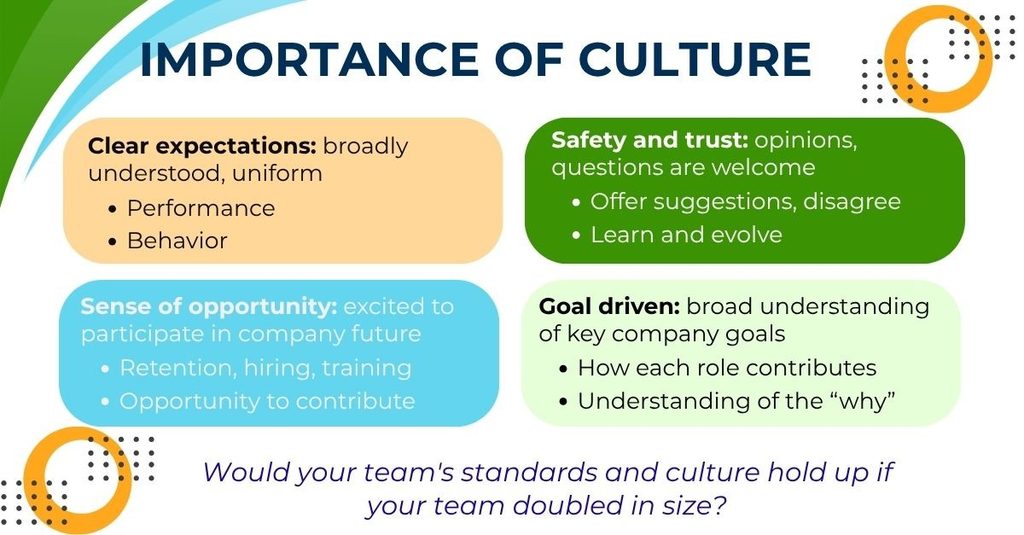
Culture is infrastructure
Our prior module, “Are you built to last”, focused on the importance of culture, because it’s critical to assembling the team that will take your company forward. You need to create an appealing place to work, but that relies on far more than perks or amenities:
- Clear expectations: everyone should understand what’s expected, not just in terms of job performance, but also interpersonal behavior, customer interactions and attitude
- Safety and trust: you need to be able to trust staff in order to delegate, but they also should feel sufficiently secure to be willing to offer suggestions, even disagree (respectfully) with managers or the owner
- Sense of opportunity: good people join and stay at companies because they’re excited about the future, both of the organization and the opportunities it may create for their personal experience and growth
- Goal driven: all of these are more readily achieved if everyone understands not just the “what”, but, more importantly, the “why” of the company’s goals and can see how their role contributes to success
Would your team’s standards and culture hold up if your team
Want more information on growing your business?
Watch the video to learn more about how to develop, review and maintain a marketing strategy that works for your business
Access our full list of questions to help you determine where and how to focus your strategic efforts
Without the right team, your business might get busier, without really producing sustainable growth. Learn more about the difference at Bootcamp #2: Are You Growing, or Just Busy and check out the full list of questions here
The right team is crucial to Creating a business that’s built to last (Bootcamp #8). Learn more here, and access the full list of questions