Where do you want to be
The core goal of this bootcamp series is to help you keep evolving toward the company you want to have. To clarify goals, understand what’s holding you back and refocus on where you want to go.
So it’s only fitting that we end a focus on how you’ll get there.
You launched this business with a goal. That goal’s probably shifted as you’ve learned more: about the business, but also about yourself, what you want, what success looks like for you.
Ironically, even as the goal grows clearer, getting there becomes challenging. It’s no longer merely a concept. You’ve built a company and that company’s developed momentum, certain rhythms, the way things work. Many of these are good, but some can stand in your way.
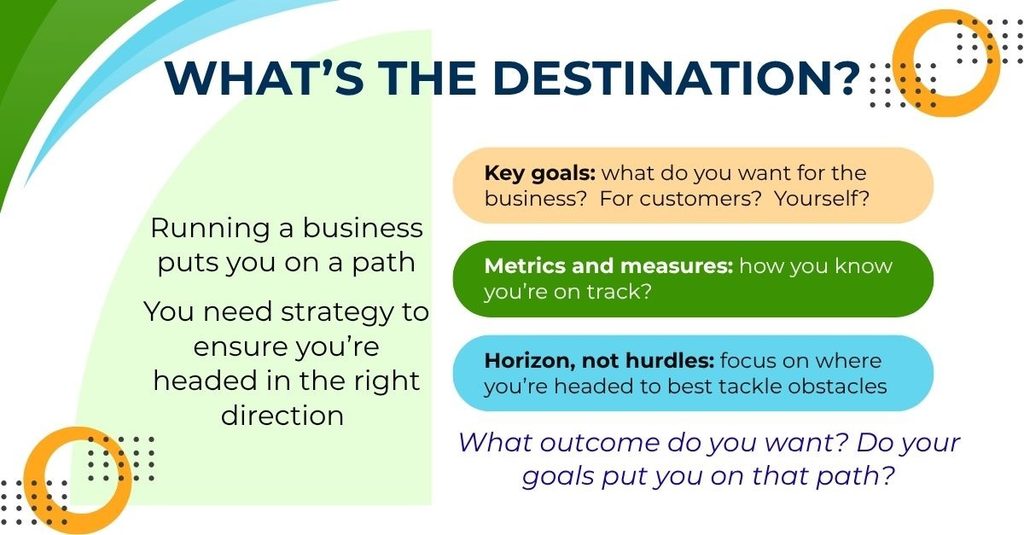
To get past the inertia, you want to focus on where you’re going, not on what’s holding you back.
- Goals: What do you want the company to be, to accomplish? What does success look like, not only for your customers, but – just as importantly – what does it look like for you, personally?
- Metrics and measures: knowing where you want to go is just the start. You need a plan to get there, with clear milestones and targets, things you can measure and assess to ensure you’re on the right track – or help you adjust as necessary.
- Look past the barriers: it’s easy to focus on what’s holding you back, what’s hard to do. You need to set your sights on where you want to go, addressing the key deterrents that keep you from moving forward.
What outcome do you want? Do your goals put you on that path?
What does success look like
Defining the goal is just the start. You’re hoping to launch a new service, enter an additional market, hit a certain revenue or earnings threshold, but what does that achievement look like? How do you recognize it (or, at least, on your way)?
You’ll want to consider multiple components:
- Customers and market: Who do you want to be serving? Where and how? What reputation or profile do you seek?
- Product or service offering: how will your service or product develop and grow to support customers?
- Staff, organization and operations: which key roles or processes are needed to support the company you’re looking to build?
- Financial profile: do you have the financial resources to reach your goal? How important is financial stability, a cash cushion, access to capital or other considerations?
- Longer term objectives: three years is a long time, but unless your goal is to sell at that point (which it may be!), what are your ultimate goals for the company (continued growth, sale, succession) and how will your current strategy help you to get there?
- Your role: where and how should you focus your involvement in the business? Perhaps you want to focus on new customers or products, take on a more supervisory role or continue participating actively in day-to-day operations.
- Your life in and outside the business: building a business is so all-consuming that it can be hard to admit that you’re entitled to personal goals as well. So what do you want outside of business? How will the company profile and your role allow you to achieve this?
What would make you feel like this was worth it, three years from now?
Recalibrate your path
Perhaps the most difficult part – and a focus of this bootcamp series – is the challenge of moving off the path you’re now on. As you build a business, you learn from and adapt to new developments, create “interim” solutions that soon become ingrained. You know them; your staff, customers and suppliers know them; it can be hard to change.
You need that existing structure; the alternative is chaos. But change requires evolving away from what you’re doing now. This doesn’t require wholesale change. Many shifts may be subtle. The key is to make sure everything’s steering in the direction you want to go.
Operational adjustments aren’t enough. You’ve got to know what you’re modifying and why:
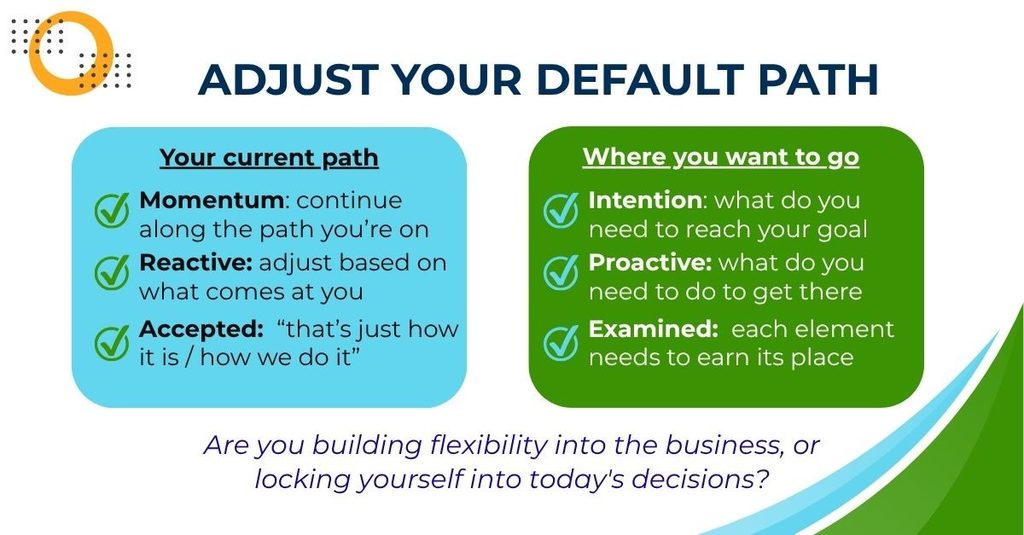
- Intention: where are you going and what do you need to get there?
- Proactive: nothing will change unless you cause it to, so what do you want to change and how will you do so?
- Examined: how does this action or initiative support that goal?
The key is to focus on goals, not activities. Defining actions locks you in; focusing on goals and adapting your activities to support them gives you the flexibility to grow and evolve.
Are you building flexibility into the business, or locking yourself into today’s decisions?
Anticipating challenges
Even as you focus on where you’re going rather than on what’s holding you back, you need to be cognizant of the inevitable stumbling blocks.
Start by examining your business today. Where are the risks?
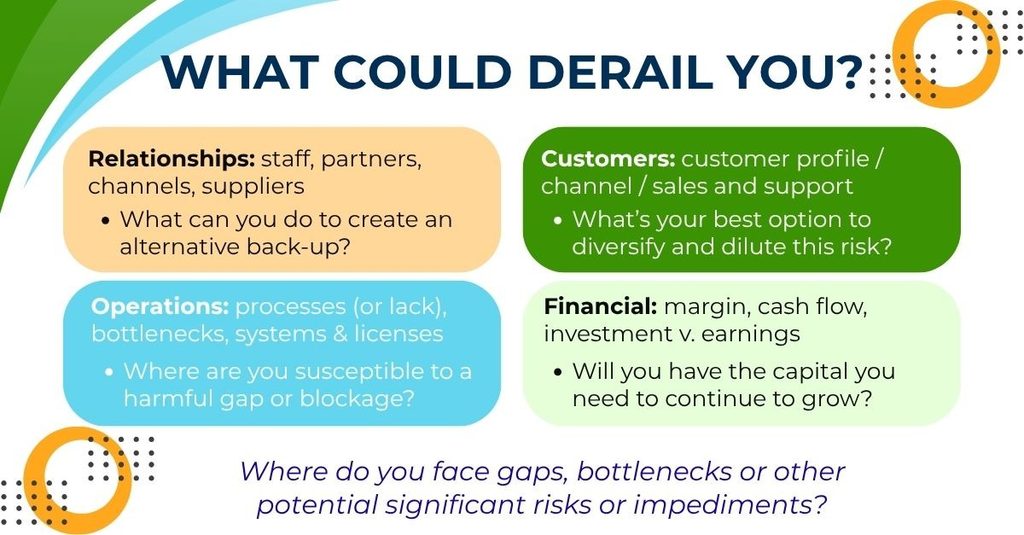
- Relationships: these could be with staff, partners, suppliers or others. Will they take you where you want to go? Do you need alternatives, back-up or even a complete change?
- Customers: will your current outreach, sales or distribution channels, support infrastructure and other elements be appropriate and sufficient for the customers you want to reach and the services or products you hope to sell them?
- Operations: what are the potential risks and bottlenecks?
- Do you need new or better processes?
- Might it make sense to improve ill-defined or overly complex structures?
- Are you reliant on systems, licenses or other external support that may limit growth?
- Financial: how solid are your margins, earnings and cash flow? How will you balance earnings versus reinvestment to grow the business? Will you have the capital you need – in a framework that feels financially secure?
(For more information on defining and targeting profitable customers, see “Are you Built for Your Best Customers”; see “Do you Have the Team You Need” for operations and relationship planning.)
Where do you face gaps, bottlenecks or other potential significant risks or impediments?
Resilience and viability
As you evolve your company toward longer-range goals, it’s not enough just to make a plan. You want to build a more sustainable, resilient, scalable company.
You build resilience by ensuring the elements of your plan interrelate and support each other:
- Revenue: How sustainable are your sales?
- Elements such as recurring revenue, repeat clients, organic growth (word of mouth, etc.) and diversification (both products and customers) all help strengthen your revenues
- Pricing power is similarly important, to protect revenues and sales as you grow
- Operations: having processes is good, but they can be unreliable unless they’re documented, repeatable and you’re able to train staff to accomplish them. In addition to internal processes, you want to think about:
- Suppliers, systems, partners: do you have alternatives and back up?
- Knowledge capture: as your business grows, your staff are doing and learning new things. How able are you to integrate these into improving operations?
- Financial: margins and profitability aren’t just a way to make money; they’re what allow your company to weather setbacks and fund growth
- How predictable are your earnings and cash flow?
- Where do you have flexibility to control costs and adjust spending as conditions change?
- How solid is your cash cushion? How can it be improved? How manageable is your debt and what can you do about it?
- Profile and reputation: your reputation is your company.
- What is it based on? How sustainable is it?
- What differentiates your business and how comfortable are you that this will persist?
- Is your reputation built from the ground up, based on customer opinions and feedback, or must it be sustained from above via marketing or other efforts?
(For more information on engineering in resiliency, see “Is Your Business Built to Last”)
Is your competitive advantage structural, or does it depend on continued effort?
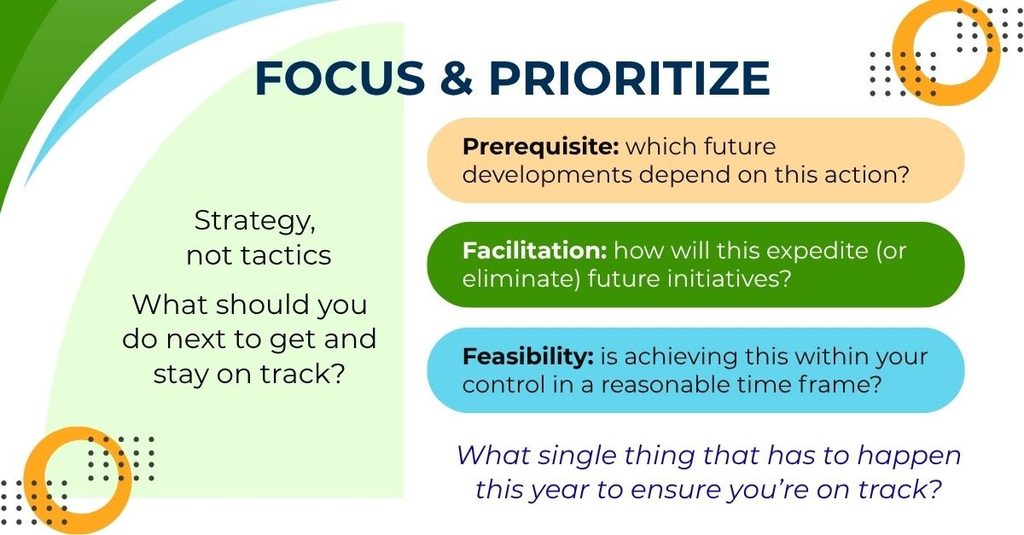
Focus and prioritize
Even with a clear objective, there’s a lot to do. Where to start? What’s most important?
It’s a tricky question. One way to address it is: what opens up the most opportunity? What do you need to get to those future steps? What can you not afford to skip if you want to reach your goals?
Asking yourself these questions can help you prioritize:
- Is it a prerequisite? Do future important initiatives depend on the completion of this step?
- How does it help? How will achieving this make future steps clearer or easier?
- Is it feasible? To help, you have to be able to implement the strategy. If you don’t yet have the resources, if your company’s not yet at the right stage, this may be an activity better left for later.
What single thing that has to happen this year to ensure you’re on track?
Define your path
Tactics are what you do now; strategy is where you’re going. Your path needs to be strategic and cohesive. Each element should be designed to lead into – and give you tools or information you need to be successful with – the following stage.
To do this, look at each element of your plan. Be clear-headed about where it leads you, what you need and whether it gets you where you want to go:
- Know the goal: for the next few months, this year, the next 2-3 years and longer term. How do they blend together into a feasible, reasonable path?
- Alignment: Does each strategic stage position you for continued success? What tools, reach, profile, knowledge do you gain to help you progress?
- Metrics: what measurable results are you seeking, both as an indication that you’ve reached your goal and to demonstrate you’re on track along the way?
- Resources: what do you need – staffing, suppliers or platforms, finances – to be successful and how will you get these?
- Accountability: who’s in charge?
- Who gets it done? Who measures success or adjusts strategy?
- How and what do they review? How frequently?
Each of these segments needs to blend together into a clear, practical route that can take you and your company where you want to go.
How will you decide whether to adjust goals, pivot or simply push harder?
(For more on reaching your goals, read “What’s Stopping You”)
Want more information on growing your business?
Watch the video to learn more about how to develop, review and maintain a marketing strategy that works for your business
Access our full list of questions to help you determine where and how to focus your strategic efforts
Access the full list of business bootcamp topics and questions here