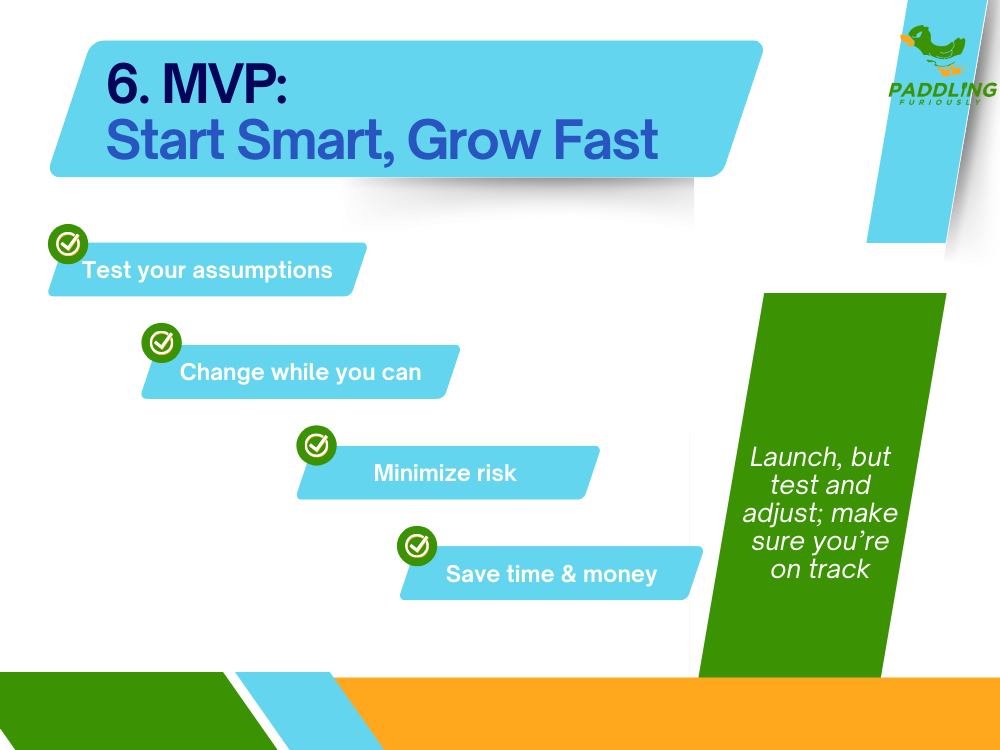
Launch Smart and Learn
Learn first; spend later
There was a time, long ago, when a business launch was a big event. Out of nowhere was born an entire product line, a fully stocked store, a professional service complete with office and receptionist.
No more. And for good reason. Not only is that expensive, it’s risky. Sure, you’ve tested, talked to potential customers, assessed the competition, aligned your goals and activities and figured out how to charge (and if you haven’t, review our earlier incubator modules!). But is that enough for you to be sure that you know what customers want, can target the right audience and deliver something that thrills them?
Maybe it is. If so, there’s no harm in starting small; you can grow quickly from there.
But, more likely, you’ve made some mistakes, missed a few things. Could be minor; might be bigger than that. Wouldn’t it be nice to find at least some of these, address them and then scale?
That’s what an MVP does for you. It reduces your investment, but more importantly, it gives you a chance to learn, react, adjust and move forward more effectively.
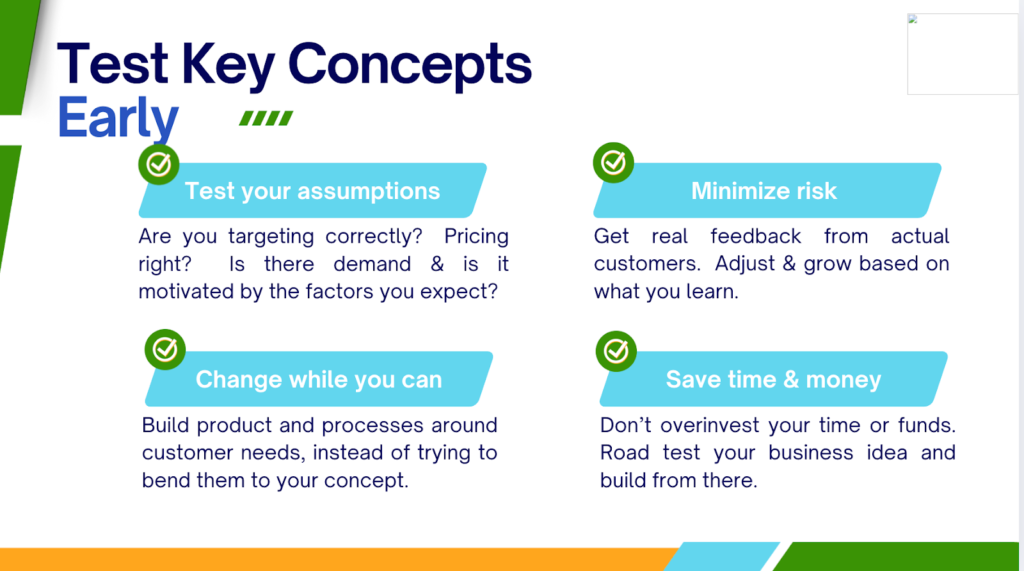
It’s about learning, not spending
The MVP approach reduces the time and money needed to launch, but more importantly, it lets you learn: in real time, through actual sales, talking to real-life customers.
Through all the planning to date, you’ve developed key hypotheses about your business: what the customer really cares about, the key aspects of your approach that will entice and excite them and the best way to deliver that. But it’s still a hypothesis. An MVP lets you test, tweak and move forward with more knowledge and lower risk.
So what’s an MVP
An MVP is a:
- Minimum: the least quantity or amount required
- Viable: capable of working successfully
- Product: a thing offered for sale
An MVP doesn’t even have to be your product or service; it just needs to be a viable offering with just enough functionality to offer something of real value to a customer. It’s a way for you to learn, not from surveys, but by sweating out the actual sales process. You’ll see what’s working and be able to adjust what’s not working before moving on to your next stage of growth.
To make this work, you’ve also got to keep in mind what an MVP is not. It is NOT:
- A mini-me version of your product:
- It will (should!) lack many features and much of the functionality.
- It may share only a few attributes with your planned product or service. As long as it’s sufficient to test your key hypotheses, it’s an MVP.
- A mock-up: it may not be the planned product, but it has to be something. And that something has to offer value to at least a subset of potential customers.
- Overly complicated:
- The goal is to confirm that you’re solving a real problem in a way that resonates with customers, not that you can address every annoyance they’ve ever faced.
- If you have to spend much of your time explaining this feature or how to achieve that arcane outcome, you’ll be distracted from your main goal: testing your hypotheses.
If you’re not embarrassed by it, it’s probably too complicated to be an MVP!
What do you need to know?
To plan an MVP, don’t start with the product and scale back; start with the problem and build from there. You’ve done the planning and testing, you’re pretty sure you’re on the right track, but wouldn’t you like to do better than “pretty sure”?
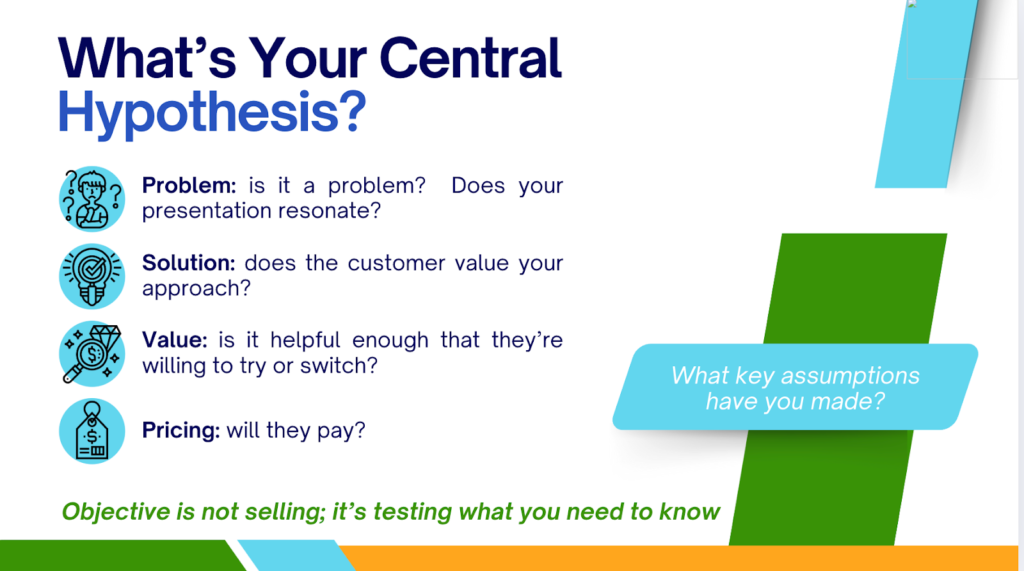
So which of your open issues are most pressing and existential? Per the chart below, these might include:
- Problem: your success depends on your ability to solve a customer’s pressing problem. Have you correctly identified the problem? Does your description resonate with potential customers?
- Solution: you’re sure you’re solving the problem, but can you convince customers? Are you approaching the solution in a practical way and can you persuade customers of this?
- Value: even if you get the problem and solution exactly right, your approach has to be compelling enough to get customers to try it out.
- Pricing: are you on track to pricing that customers will accept and that will allow you to generate profits. (Realize, of course, that you may not be able to charge full price for the MVP.)
What will you measure?
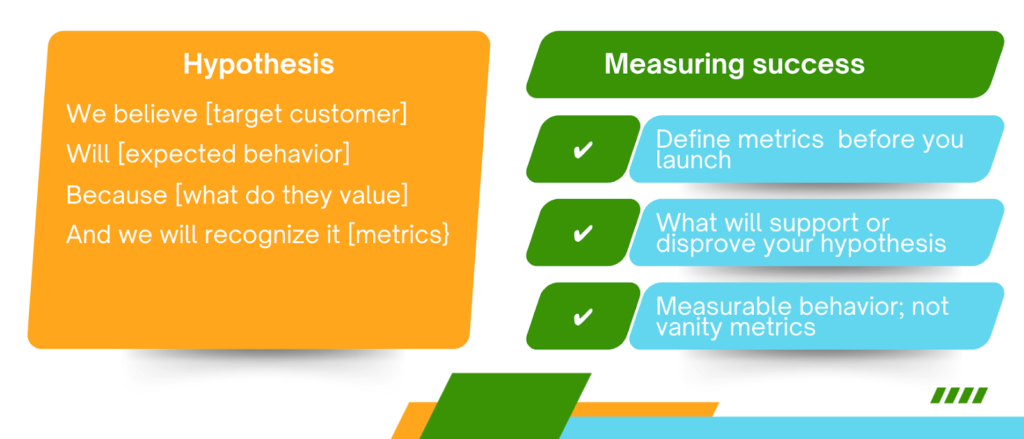
Since the goal of the MVP is to learn, it’s important to define what success looks like. What metrics will indicate that you’re on the right track, that you’ve made reasonable choices.
Pro tip: identify these in advance. Once you’ve launched the MVP, reality gets quite messy. It’s too easy to look at this and decide you see what you want to see.
There’s far more rigor if you define the metrics you’re hoping to achieve before you launch. You can always adjust these once you see actual results, but you’re less likely to manage to the results, instead of learning from them.
Where do you go from here?
The MVP is just one step on the road to a thriving business. So, while you should be focused on its success, you also have to know where you may be able to go from there.
Practically, this means that, in addition to the metrics themselves, you’re going to want to have some idea regarding the consequences of particular outcomes. Once set of results may indicate that the product design is okay, but you’ll want to seek a different customer target; another may steer you toward changing the way you use or explain certain attributes in selling to this base; a third may encourage you to seek a partner.
Again, you don’t have to follow these exact paths, but knowing in advance where you hope to go can help you get there.