Time to Make a Plan
From product to business
So far, you’ve been focused on your service or product. Why will a customer care? What are they using now and why would they switch? What other options do they have?
These questions help you create a differentiated product that customers will love. But a product is not a business. A business needs to make money and sustain itself. So how on earth do you turn all this into a business?
What you need is a way to start to pull all these disparate concepts together and, more importantly, figure out how they mesh and align. The business model canvas can be a great tool for doing this.
What is the Business Model Canvas?
The business model canvas (“BMC” from now on) is a one-page business planning tool. It’s not a business plan – more on that below – but it’s a flexible, user-friendly and often very valuable tool to help you plan your business.
The BMC puts all the key elements of running a business onto one page. You can – in fact, you’re forced to – think about how the pieces interrelate, how things work, what you need to do, how much that will cost and how you can make money doing it.
Because it’s small and quick (though far from easy!), it’s great for:
- Brainstorming to create a business framework from those initial findings
- Examining alternative products, partners, strategies or any other elements of your plan
- Taking a closer look at individual products or channels
- Revisiting, tweaking or pivoting elements – or all – of your business on an ongoing basis
| Business Plan | Business Model Canvas | |
| Form | Detailed narrative, multi-page | One-page, key points or bullets |
| Purpose | Communicate a finalized plan | Brainstorming, test ideas, build and expand |
| Primary Audience | Investors, lenders, partners, extended team | Founders, advisors, internal team |
| Stage | Ready to launch, strategic growth | Pre-launch, interim planning, sub-planning (product, stage, etc.) |
| Update Frequency | Infrequent | As needed |
Why not a business plan?
Business plans can be very helpful, but they’re long and complicated. It’s not a format conducive to winging it or what-ifs. Testing with the BMC can allow you to solidify a cohesive vision of your business and the necessary elements.
Think of the BMC as an outline or roadmap. It can readily serve as a framework for a full business plan. Or you may choose to develop individual, detailed plans for key elements, such as marketing strategy, partnerships, etc. You’ll have created a foundation and can proceed in whatever manner works best for you and your business.
Using the BMC
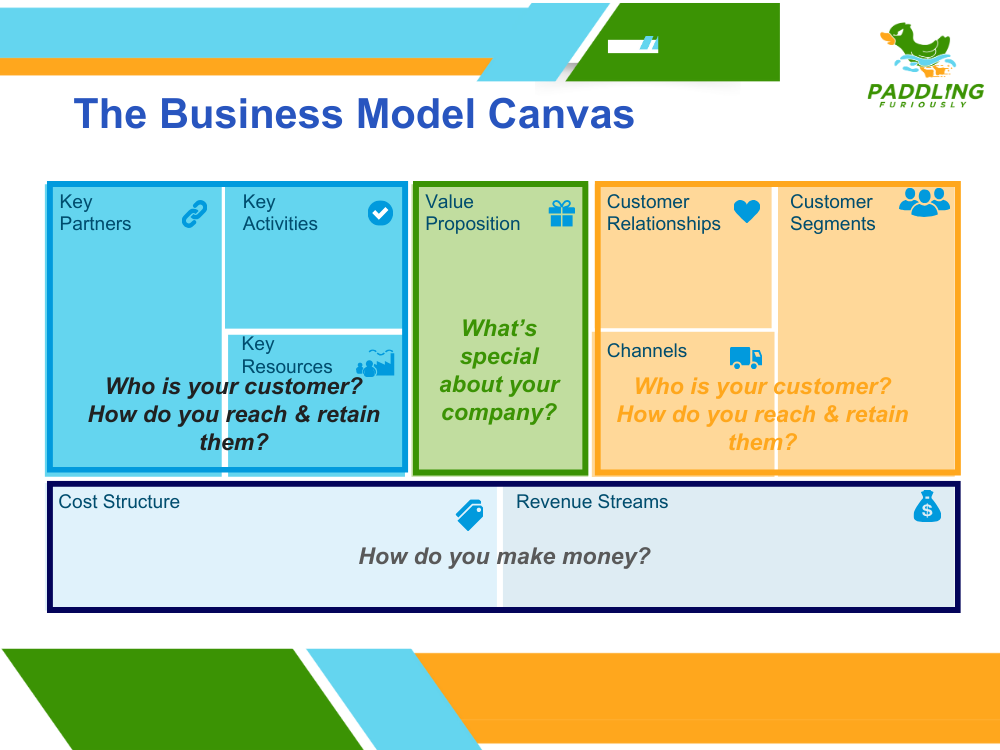
The BMC consists of 9 boxes, grouped into four major sections:
- Customer value proposition occupies the center of the page, since your business and all its activities should center on understanding and meeting the customer’s needs
- Customers occupy the upper right corner; on the page, as in your business, customers and value proposition are linked via channels and relationships, namely, how you reach and support your customers.
- Customer segments must be aligned with value proposition; which customers care most about each element of your business
- Channels: how do you reach, communicate with and deliver your products to your customers?
- Relationships: how do you interact with a customer from first impression through the entire lifecycle?
- Operations are summarized in the upper left, with a structure mirroring that of the customer side – your key partners in the corner, connected to your value proposition via activities and resources.
- Partners: other parties you rely on, such as suppliers, partners, technology providers
- Activities: what necessary to produce your product or service, reach & support customers, maintain relationships and generate revenue
- Resources: can be physical (equipment, materials), intellectual (IP, brand, processes, customer lists), human (staff, contractors, advisors), or financial (cash, loans, investments)
- Financial elements are at the bottom of the page
- Revenues reflect the activities you undertake for and products you sell to your customer segments
- Expenses are the cost of the resources and activities necessary to support operations
Getting the most from the BMC
While seemingly simple, making optimal use of the BMC requires thought and effort. To get the greatest value from the process:
- Start with customer and value proposition, since these are central to your business
- Focus on prioritization and alignment:
- Instead of working block by block, focus on one customer group at a time, detailing the activities, resources and other elements necessary to be successful with that group
- Space is limited, so include only key customer targets, major partners and most important activities
- Remember corporate activities: the customer comes first, but you’ll also need company-wide actions (branding, website, legal, HR, etc.) to support those activities
- Use it as a springboard for ideas: working on the BMC often triggers ideas and questions, other activities you might consider, customers or products that might be interesting at some point. Don’t let these go to waste! Keep a list for future reference.
- Create supporting BMCs: want to look more closely at a particular product, channel or customer type? You can create a BMC just for that.
A living document
Another advantage of the BMC’s speed and flexibility is that you can (and should!) revisit it often. Particularly in the planning phase, if you adjust one element of the plan, make sure to follow through the relationships outlined in the BMC to determine whether other changes need to be made.
Even after launch, it can be very helpful to check back with the BMC. Where were your assumptions off? What adjustments can be made. What other, new ideas might you think of?
Additional resources:
Video explainer – what is the business model canvas and how can it help you
Business Model Canvas template: Google Doc or Google Slides