Your customer has many options
By now, you’ve analyzed the value you offer and understand why a customer might care enough to switch. But if the problem you’re solving is as compelling as you think, you have competitors.
Being the best solution only matters if the company believes that and votes with their wallet. So, important as it is to think hard about what you’re building and why, you’re going to also need to look around you, understand your customer’s other options and develop a plan to win.
Broaden your definition
Too often, business owners think of competition as other companies providing roughly – or, worse, exactly – the same service or product. If you look at it this way, you’ll miss significant competitors and potential risks.
Competitors include:
| Any company, product, service or individual that helps your customer achieve their goal. | Example: If you’re developing a shopping-list app, your competitors include not only other apps, but also things like a whiteboard on the fridge. |
| Any choice that prevents the customer from choosing you, including processes and workarounds | Example: If the potential customer’s gotten in the habit of using their phone to take photos of the inside of the fridge, that’s also competition |
Importantly, a major competitive risk is the customer’s option to do nothing, choose no vendor, buy no product.
Where do you compete?
So it’s crucial that you think both specifically and globally.
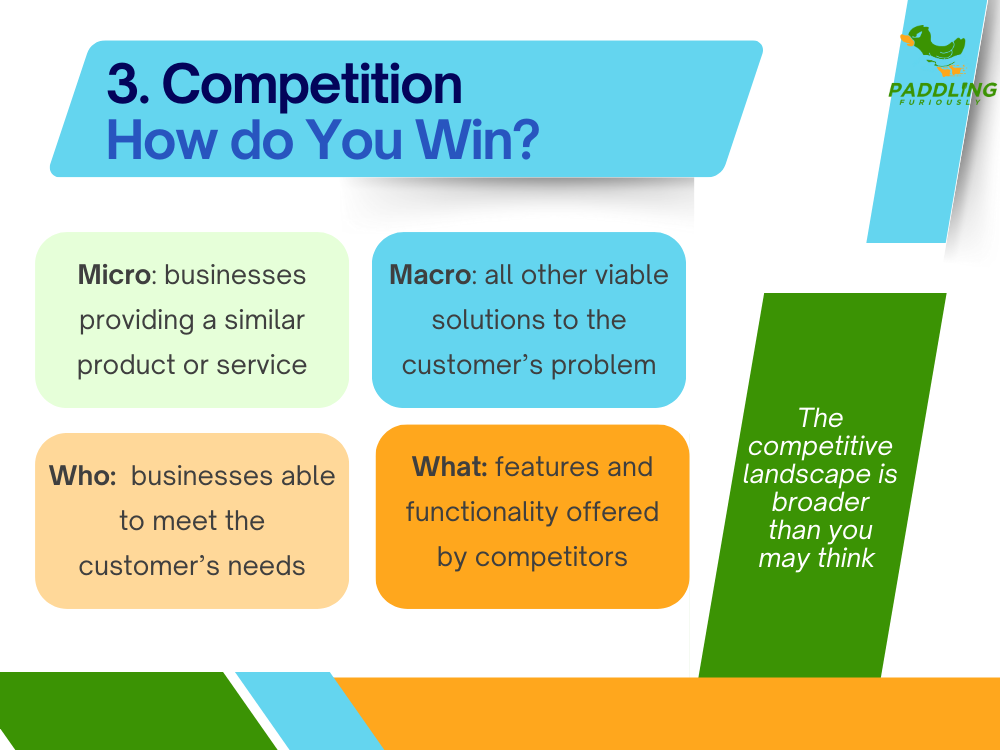
- Micro: other companies providing a similar service or product
- Macro: all the other ways in which your customer could solve the problem
- Who: all the other companies able to provide a solution, broadly defined
- What: the nuances and types of solutions provided
For example, if we’re thinking about launching a dog-walking business, our competitors include:
- Local dog walkers
- Anyone else who could walk the dog, including neighbors, family members
- The backyard, doggy day care, a pen or other solutions that obviate the need to walk the dog
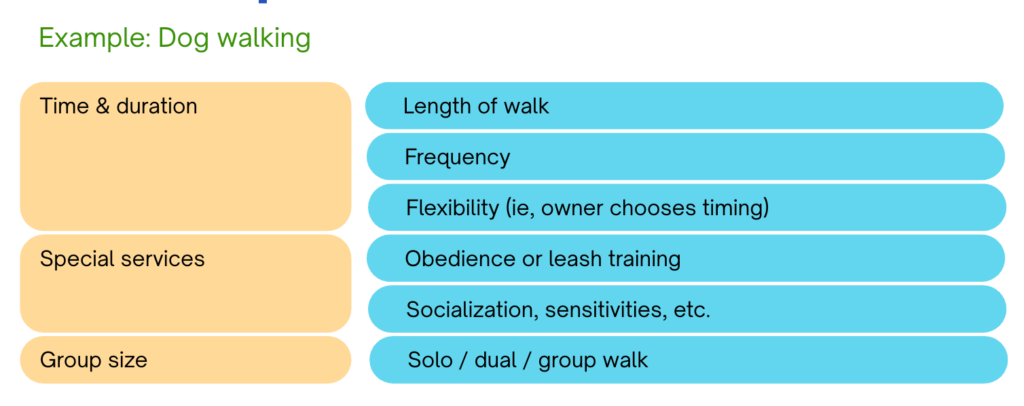
There are also numerous offerings and aspects of your potential offering and competition
Don’t ignore your #1 competitor
All companies share the same competitor: apathy. Don’t forget that your customer also has the option of doing nothing, making no change whatsoever.
If the problem is as pressing as you think it is, the customer’s already addressing it somehow. It may be a terrible solution, yours may be unbelievably better. But the customer has a lot of other things to worry about. If it’s working, why change?
You’ve literally got to be “better than nothing”.
Where do you compete?
In evaluating competitors and your competitive positioning, you also have to think about where you compete. For example, if you’re opening a restaurant, you could compete:
- Worldwide: you’re building an international reputation and will draw diners from everywhere
- Citywide: you’re going to be a well-known local restaurant
- Neighborhood: others may visit, but you’re counting on nearby regulars and a neighborhood reputation
This is called your Addressable Market, the total number or sales value of potential customers. There are trade-offs involved:
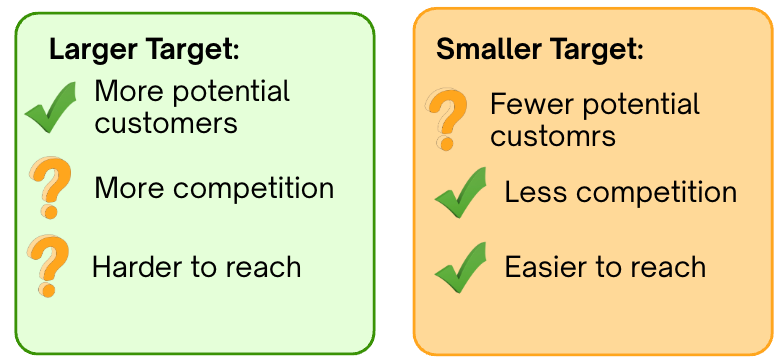
Often, a newer business, product or service is better off aiming for a more limited market. These more limited targets are sometimes called:
- Serviceable Addressable market (“SAM”): the portion of the total market that you’re currently able to or actively seeking to reach
- Serviceable Obtainable market (“SOM”): the portion of the current total market that you can realistically capture near term
- These are portions of your Total Addressable market (“TAM”), the customer base you might ultimately hope to target
What makes you special
All companies have competition, so the fact that you’ve now learned more about yours is a positive; it helps you better define your differentiation.
- What is the total market you might ultimately hope to reach (“TAM”) and where can you logically and effectively start now, (“SOM”)
- Who are your competitors, both now as you’re launching and longer term? How can knowing this help you prioritize features of your product or service, target and convince potential customers and position your company for strong, long term growth?
- With this in mind, what is your Unique Selling Proposition (“USP”), the features, functionality, customer service or other aspects of your business that make you special
Important note: low price is typically not a sustainable or profitable USP 😉
SWOT = Competition at a glance
As you can see, a lot goes into evaluating the competition and assessing how you can best position your company. A SWOT analysis can help you summarize what you’ve learned and focus on the most important aspects.
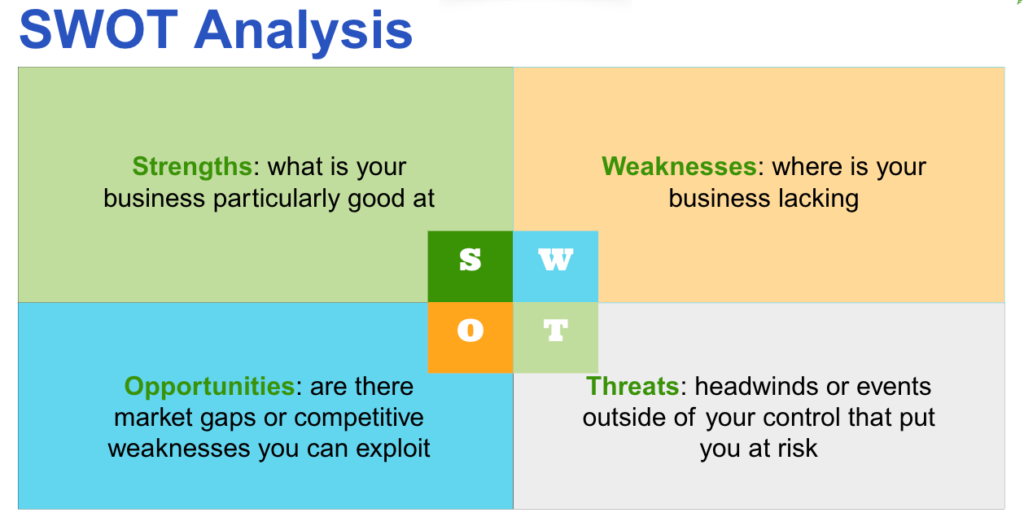
In a SWOT analysis, you list your company’s:
- Strengths: What is your USP? What value do you provide to customers and/or how will your reach, support or otherwise assist them in a way that stands out from the competition
- Weaknesses: All businesses have weak spots; ignoring yours won’t make them disappear. Assessing them lets you better understand how to address and counterbalance them
- Opportunities: with your enhanced understanding of the market and competition, where are there gaps or competitive weaknesses that offer an opportunity for your company
- Threats: beyond the competitors, every industry is subject to external forces and events that could be harmful. What could affect your company and how can you get ahead of this threat?
How does your company compete?
As always, we have resources to help you assess your product or service’s competitive positioning. You can access competitive assessment and SWOT worksheets – and a guide for comparing your assessment to AI-assisted findings – here (you must be logged in to access.)