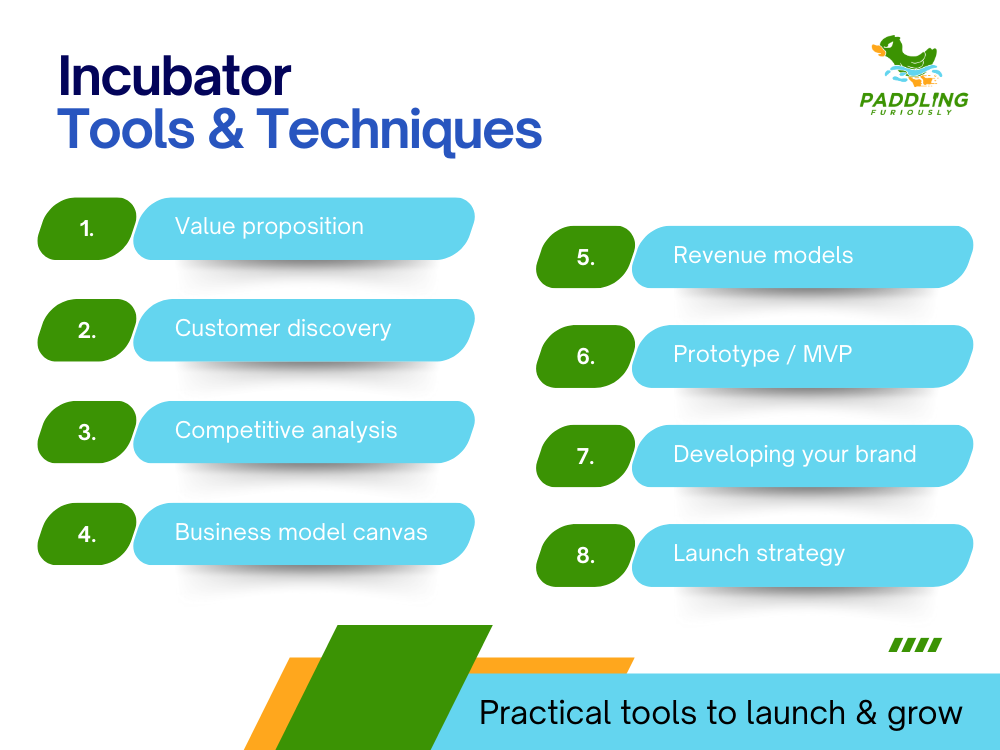
Practical techniques and tools to help you launch and grow
| Module | Why it Matters | Full Post | Tool: Introduction & links |
|---|---|---|---|
| Introduction | How can this incubator program help you? What will you learn? | Creating a complete, aligned and customer- centric business plan Read more here |
- Introduce your company - Define your goals Access goal setting tool |
| 1. Customer Value Proposition | What does your customer care about? What are their goals? | What does a customer need? Why will they care? Read more here |
- What does your customer want or care about? - How can you help Access value proposition tool |
| 2. Customer Discovery | Instead of guessing what you think the customer will use, start by finding out what they need and why | How does the customer think? What problems do they face and what would motivate them to change? Read more here |
- What do you most need to know about your customer - Where are you uncertain - Identify areas for further research Access discovery tool |
| 3. Competition | To compete, you need to understand all the ways in which your customer might solve this problem | Is the customer using a competitor? Do they have a workaround? Are they doing nothing? You need to know Read more here |
- Identify direct (micro) and broader (macro) competitors - SWOT analysis Access competition tool |
| 4. Business Model Canvas | Whether launching or growing, you need a plan. The business model canvas is a one-page, flexible business tool to help you grow | Prior posts focused on the customer and planned product or service; the BMC can help you build a business around it Read more here |
- Business model canvas template - Resources to help you plan Access business model canvas |
| 5. Revenue models | There are many ways to get paid. Choosing one that aligns with customer needs and your costs will speed growth and enhance profitability | To price well, you need to align your pricing to what customers value, and cover your costs while doing so Read more here |
- Understand your costs, including time, across the customer lifecycle - Prioritize pricing options: what’s practical now + longer term goals Access revenue tool |
| 6. Prototype / MVP | Whether you’re launching a business or adding a new product or service, an MVP approach will help you reduce cost and risk while enhancing flexibility | With an MVP approach, your launch can be an opportunity to learn more, build smarter and continue to center the customer Read more here |
- What is your MVP hypothesis - What will you offer - Whom will you target - How will you measure Access MVP tool |
| 7. Building Your Brand | You’re building your brand every day, with every client interaction. With some simple planning, you can control how the brand develops – and use it to help your business grow efficiently. | Building a brand doesn’t have to cost much money, but a good one can help you make money by helping customers find you and building trust that leads to sales. Read more here |
- Revisit your core value proposition - Brand philosophy - How should customers see you? - Finding your brand voice Access branding tool |
| 8. Ready to launch | Done well, your “launch” is a thoughtful, measured step toward the business you’re looking to build. Learn how to plan the launch strategy that works for you. | Iterative growth can get you farther faster, based on phased planning that allows you to learn, improve and move on. Read more here |
- What product or service are you launching with? Who is the customer? - Define goals, next steps - What do you need? How can you minimize cost & risk Access launch tool |