Closing the “vision gap”
Most founders have no shortage of ideas. For every one you implement, you’ve got three more just as good, as soon as you can get to it.
At that rate, how can you ever catch up?
The goal’s not to do everything you can think of. (If you’re being honest, some may not be that worthwhile.) But even a severely edited list leaves plenty of projects.
So what’s holding you back?
It’s not just you. Many young businesses reach a point where they’re stuck. Something’s blocking you.
To address that blockage, you’ve first got to figure out what it is. It helps to:
- Have a well defined, clearly articulated goal
- Thoughtfully assess the impediments:
- Which are truly blockages
- Which are bottlenecks or other constraints that can be addressed
- What else might be holding you back: tough decisions, difficult conversations, a need to face or admit to past actions that aren’t working
- Knowing how you might address the block, how much do you truly want to take that next step, knowing that all growth involves some risk
What stands in your way?
Barriers to growth often appear as tangible needs; if you just had more money, more staff, more suppliers or partners, you’d be on your way.
These may, indeed, be issues. But often, the problem is more foundational:
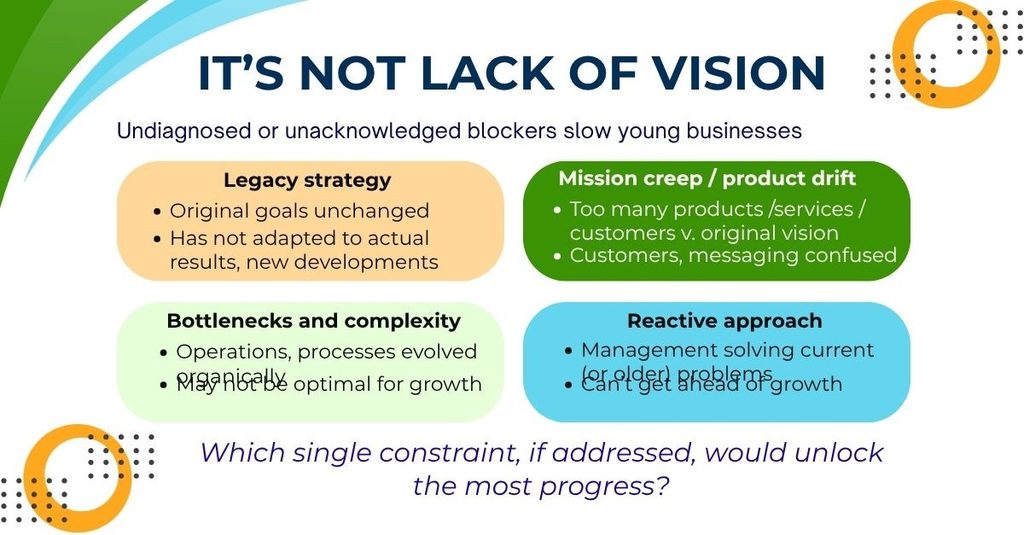
- Legacy strategy: you started your company with a plan built around your original vision.
- You’ve learned a lot since then.
- New opportunities, challenges or competitors have arisen
- Have your goals kept pace?
- Mission creep / product drift: conversely, some companies readily and regularly adjust strategy
- New products or services are added in response to customer interest, competitive actions or simply a sense something else might work
- Diversity and choice are good, but too much undirected growth can overwhelm operations or cloud your brand and messaging
- Bottlenecks and complexity: as you expand and add products or services, pursue new customers or channels, your business grows more complex
- This “busyness” and complexity can, in fact, be an impediment to growth (see Module 2: Are You Growing or Just Busy?)
- You should try to address complexity and improve efficiency as you grow; but legacy issues need action. They’re stalling your growth
- Reactive approach: it’s hard to try new things and introduce innovative solutions if you’re stuck solving yesterday’s problems. To build a true foundation for growth, you’ve got to start looking, planning and hiring ahead (see Module 8: Are You Built to Last?)
Which single constraint, if addressed, would unlock the most progress?
Define the goal
It’s hard to recognize a barrier unless you know where you’re going. Sure, you have a sense of what you’d like to be able to do, where you’d like the company to go. But until you define the goals and set measurable targets, it will be hard to see – and thus clear – the path forward.
- Goal: Implementation may be complex, but the goal should be clear. Ideally, you should be able to explain it in a few sentences.
- A clear goal allows you to prioritize the capabilities or tools you’ll need to get there
- If you can’t access or implement these necessary elements, then you’ve defined a constraint… which you can work to address
- Objectives: knowing the goal is only a starting point; you need clear metrics and measures to be able to assess if you’re on the right path and recognize whether or not you’ve arrived.
How will you know that you’re building the business you want?
Bottleneck or block?
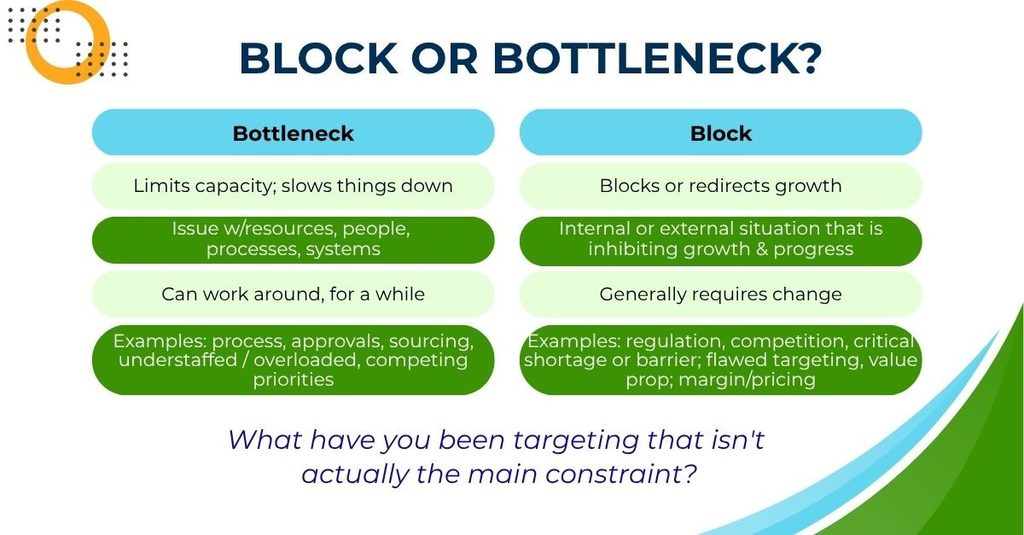
Once you’ve defined your goals, there may be multiple elements standing in your way. Not all of these are true constraints. Some are bottlenecks – capacity or other impediments that can be addressed.
Bottlenecks can sometimes feel insurmountable, but they can typically be alleviated with additional resources, improved processes, better systems or other operational fixes. They tend to slow – but not completely prevent – progress.
A block is a solid obstacle blocking the path forward. It’s often binary: you either can get through it or you can’t.
Which is which? Ask yourself:
- What’s slowing us down? That’s a bottleneck.
- What’s preventing us from getting where we’re trying to go? If additional resources can’t provide a fix, you may have a block
What have you been targeting that isn’t actually the main constraint?
What’s blocking you?
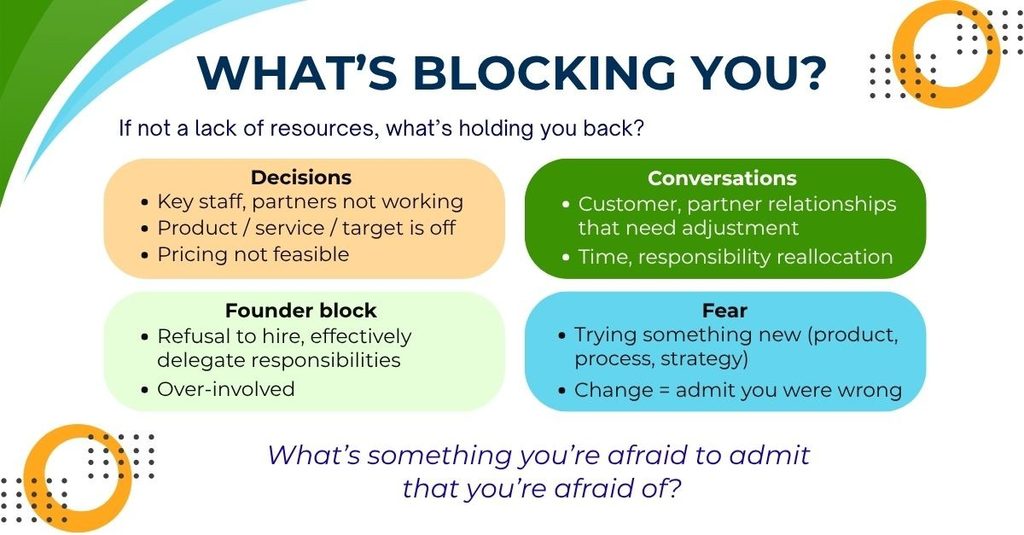
Having alleviated – or, at least, defined – the bottlenecks, you can turn your attention to what’s truly blocking you. These may include:
- Decisions: you may already know what needs to be done. For example, your pricing, product set, targeting or other business elements may not be working. Addressing these issues may involve (perhaps multiple!) difficult decisions. But you can’t move forward without them.
- Conversations: perhaps you’ve made a decision, but now need to have an uncomfortable conversation with an employee, partner, supplier or customer. These, too, can be constraints – but they’re surmountable.
- Founder block: sometimes you, the well-intentioned, deeply committed founder, can be the problem. If you’re unable or unwilling to make adjustments to roles – your own and others’ – or the way in which you interact with business operations and decisions, you may be standing in the way.
- Fear: while few founders want to admit it, fear often plays a significant role. You know how hard it was to get here, how much work and how many setbacks it involved.
- Making changes may mean implicitly admitting that you were mistaken
- Adding something new will require you to risk at least some of the stability and value you’ve built in the hope that something different might be better.
What’s something you’re afraid to admit that you’re afraid of?
Have you outgrown yourself?
What unites the elements above is change; what used to work no longer does.
That this is natural and very common doesn’t make it any easier to deal with. In fact, it makes it harder, since it means you need to confront or change the people and practices that got you where you are today.
- Habits or approach: when you started, you may have solved problems on the fly, introduced new products when inspiration struck or given people big tasks you hoped they’d figure out. It was improvisational and exhilarating; it helped build your business. But now you may need to adapt.
- Relationships: You built this business with key employees, valued advisors and major customers. While you should always cherish all they’ve done for you, that they helped you in the past doesn’t – sadly – mean they’re still the ones to move you forward.
- Operating style: successful companies continuously adapt their operations. It’s not glamorous; it can feel as if you’re wasting time that should be devoted to new initiatives, but it’s natural and necessary.
What element that built your business might now be holding it back?
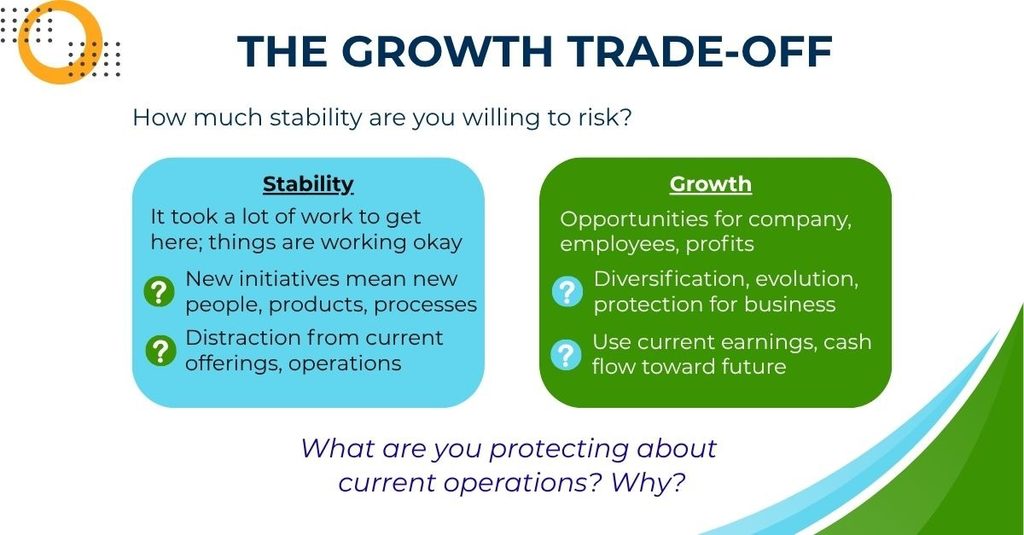
Risk is always an element
Another underlying blockage is a recognition of the risks involved. It’s taken a lot of work to get where you are, to overcome mistakes and setbacks, to find the right people, to establish your brand and build customer trust.
Additional growth will put all of these at risk, at least to some extent.
- You’ll need to introduce new products and services, target other customers or segments, pursue additional partnerships or marketing channels, create processes to support them and accept the errors and learning process that comes with each of these
- These efforts will distract from what you’ve already built
- Investment in new initiatives will divert cash flow and profit you rely on the fuel your business
Why risk it? Because it’s the only way to grow, diversify and strengthen your business.
But the timing and rewards – if they occur – are uncertain, while the risks are clear. There’s no immediate penalty for delaying, so it’s natural to do so.
But you can move forward, despite the risk. You’ll just need to protect what you’ve built:
- Make sure you have the right people in key roles and they have sufficient authority to get things done
- As you develop new products and activities, work to put processes in place as soon as practicable, reducing the risk of these new initiatives
What are you protecting about current operations? Why?
Confront what you can’t control
We’ve listed common internal blockages, but some are truly external. Just because you can’t control them, however, doesn’t mean you can’t – or shouldn’t – deal with them. You’ll just have to find a way to work around or through them.
- Completely external: Things like regulation, the economy, catastrophic events, technological changes do occur. Not all will meaningfully impact your business, but when they do, you have no choice but to adapt.
- External, but manageable: Other factors that arise outside your company may be easier to deal with. Things like competitive conditions, supplier reliability or pricing, changes to platform algorithms and other such developments can feel like blockages – and often are, at least temporarily. These are not unusual, however, and managing through them is a key aspect of running a growing business.
- Masking an internal issue: Some seemingly external factors arise due to internal conditions. Is funding truly unavailable, or is there a reason your company’s not prepared to access it in the amount you wish? Is your technology really insufficient, or do you need better training and processes supporting it?
Is it truly external? Is there a way to work with or around it?
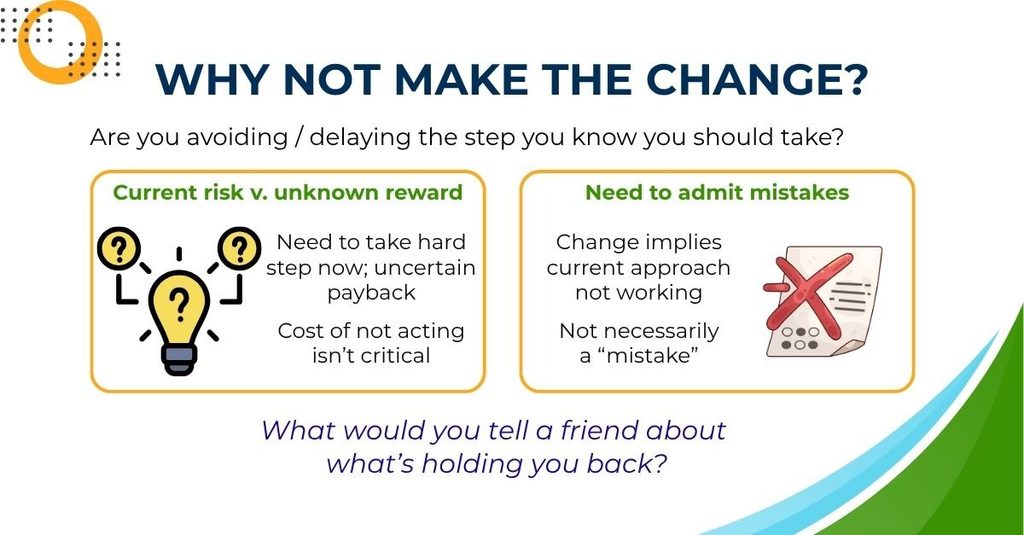
Why not make the change?
As should be clear, growing businesses often face obstacles, but most are not actually insurmountable. Often they involve actions, choices or risks you’re not yet willing to take.
That’s fine. Part of our thesis is that you get to build your business and define success your way. But if you still want to grow, you may need to confront one of two issues:
- Current risk v. uncertain reward: Doing new things involves risk, stepping into the unknown, potentially jeopardizing some or all of what you’ve worked so hard to create. And there are no guarantees; it may not work and, even if it does, it’s hard to know when or how successful it might be. But you took a similar – and greater – risk to start your business. Doing so again, from the platform of all you’ve created, may feel risky, but it’s an important way to strengthen and protect your business.
- Acknowledging mistakes: Making a change implies that whatever was there before is no longer working.
- That doesn’t necessarily mean your prior decisions were mistaken; you’re simply responding to the natural evolution of your business, customers or industry
- Even if you were mistaken, you’ve learned from it and can move on stronger
Start by being honest with yourself: What would you tell a friend about what’s holding you back? Someone to whom you can admit mistakes, fears, concerns? Someone who won’t judge your competence or decisions, who just wants you to succeed on your terms.
Then, once you’ve admitted what’s stopping you, why not do it? It doesn’t have to be a huge leap, just a simple commitment: what will have changed one year from now? Be specific, provide metrics. Get going.
What’s one action, with one specific date, you’re willing to commit to?
Want more information on growing your business?
Watch the video to learn more about how to develop, review and maintain a marketing strategy that works for your business
Access our full list of questions to help you determine where and how to focus your strategic efforts
To move forward, you need the right team and a willingness to delegate true responsibility. Learn more at Bootcamp #9: Do You Have the Team You need? and check out the full list of questions here
Complex and improvisational processes can stymie growth. Learn more at Bootcamp #4: Is Complexity Hurting Your Business? and access the full list of questions here.