How much is too much?
Businesses grow. They evolve. They get more complex.
That’s great. That’s how they expand. It’s also how they get overwhelmed.
You start small, you’re focused on your vision. But then the customer asks for something. Seems like a good idea, so you add it.
You discover an additional channel to boost sales. More customers and broader distribution lead to an expanded marketing strategy.
Operationally, of course, you learn so much. You fill in gaps. Mistakes happen, so you add processes to prevent them. And all the new initiatives have support needs and processes of their own.
Great… for a large business that can handle all this. But you’re still young. You want to stay nimble, responsive. You don’t want a burgeoning bureaucracy you don’t need and can’t afford.
Has “flexibility for the customer” become “chaos for the team”?
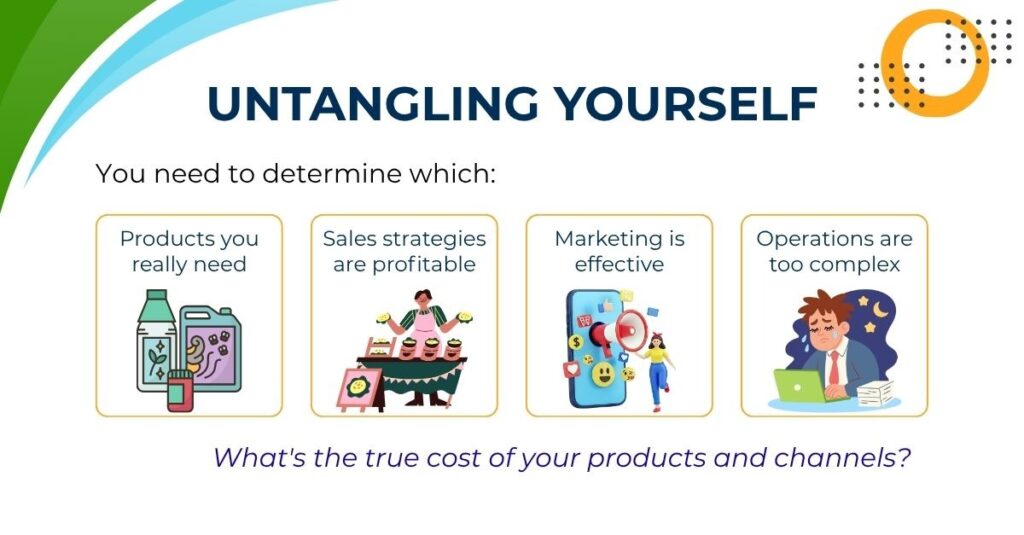
Untangling yourself
Battling back the complexity isn’t that hard; you probably already have a sense of what you need to do. You need to:
- Evaluate the core products or services that truly drive your business, as well as the value of others that support them, provide new opportunities or have other benefits
- Analyze your sales and marketing efforts to insure that you’re:
- Focused on the customers and channels that will drive profitability and growth
- Communicating clearly, without undue diffusion across messages and platforms
- Ensure that the operations and other support aspects of each is in line with its growth and profitability
What’s the true cost (not just financial) of your products/services and channels?
More products don’t equal more sales
“Give the customer what they want” can be a compelling mantra when growing a business. You’re young, scrappy, hungry for sales. The customer wants that product, but bigger and blue, or the same sort of financial planning service, except focused on their parents, or teen-aged kids? No problem. You’re there.
The customer is thrilled (hopefully). In some cases, you are too; you’ve found a great new source of demand. But repeat that too many times and you can end up with an array of services that even you can barely keep track of.
No worries, you think; it’s worth it because the customer has more choice. Ergo: more chances to & likelihood they’ll buy.
Not necessarily. Often, too many service or product offerings mean:
- Customers are confused or overwhelmed, and may end up choosing none of the options
- Sales and marketing efforts become less effective as they’re diffused across multiple products or services
- This confusion makes it harder to build a brand and more difficult for customers to recognize your company’s value proposition
- The operational costs of supporting so many products outpace their incremental contribution to sales
The key is to focus on the 80/20 rule: 80% of sales typically come from 20% of your services or products. Do you know which these are?
That doesn’t mean you need to have to get rid of all the others. Some may be good feeder or introductory products; others are newer offerings that have potential. Just make sure that:
- You understand the value of each of the “keepers” and why it should stay in your line up
- You’ve thoroughly evaluated all the related costs and are confident each provides a solid contribution to your bottom line
If you could sell only three things, what would they be?
Channels can enhance – or crush – efficiency
Sales channels, partnerships and distribution deals can be a great boon to young companies, allowing your limited team and resources to go farther by relying on others who may have deeper, broader or better-established relationships than you do.
It’s a way to do more with less. Who wouldn’t want that?
You might not… if all those channels start requiring more effort, expense and complexity than their sales justify.
Which of your channels is truly effective? Revenue generation is great, but worthwhile channels:
- Produce more than they cost in terms of effort, operational support and other costs
- Add to your customer base, brand awareness and reach
- Truly help you grow, now and longer term
Which channel would you miss least if it disappeared?
Marketing must build and support your brand
Your brand has been central to your business from the start. You had an image that guided your original concept. You developed it further as you refined your business plan. It was and remains key to who you are, to how customers see you.
You wouldn’t risk your brand by doing too little; are you risking it by doing too much?
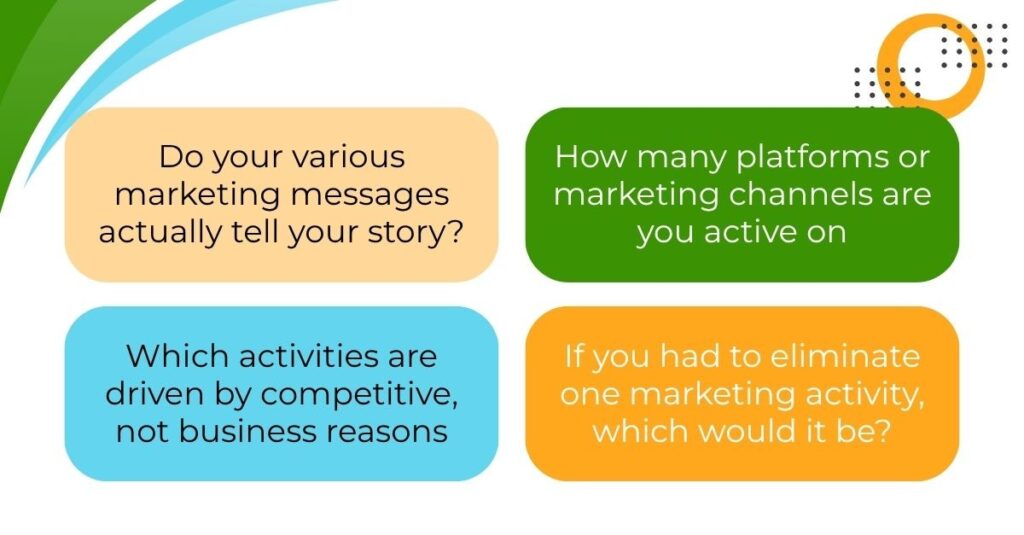
- Many businesses tailor messaging to each customer and platform. As these proliferate, that creates extra work, but may also may mean customers encounter multiple messages, which could make your brand, make it less clear and compelling
- Your business has evolved; which message best represents your brand? Which of your platforms or efforts are the strongest representation of the message you want to send?
- Assess your rationale for each marketing effort: is there still a strong business case for continuing?
If you had to eliminate one marketing activity, which would it be?
True cost goes well beyond margin
The key is to understand the “real cost” of the product, channel, marketing effort, etc, including:
- The direct costs of that product, service, channel or activity
- Operational costs, such as logistics and support
- The costs of training and supporting staff, whether your own or those of channel partners, service providers or others
- The relative complexity of each activity, the confusion it may cause for your staff or customers, the time involved in resolving questions and issues and other factors. These add time to training, sales and other activities, which means it’s costing you more
- Lastly, more complicated activities are generally more prone to error. Each error puts the transaction, customer relationship and even your brand at risk. That’s hard to quantify, but it’s a significant potential cost
Which products are most likely to confuse employees, generate questions, cause errors?
Your role in creating – and reducing – complexity
As the business owner, you helped create this complexity — and you had a good reason to do it! But it means you can help address it.
Start by being honest with yourself about why you’ve added these services, developed more complex processes, multiplied your marketing messages or distribution channels:
- It was — and still seems to be — working. (Follow on question: even if it’s working, is it adding value?)
- It’s fine; it’s how things are done
- You’re aware there’s an issue don’t have time to simplify
“How things are done” indicates there’s probably room for improvement. “Don’t have time” is more urgent.
Operational issues rarely take priority. New products, adding staff, growing your business will always take precedence.
But remember: all that adding is what got you to this place. So now is the time to cut back and simplify, to give you a stronger platform from which to pursue new value-adding activities.
Now that you understand the true cost of complexity, you can’t afford not to.
Just ask yourself: What’s the worst that could happen if you simplified your products, sales or operations?
Want more information on growing your business?
Learn more about complexity from this video
Ask yourself these questions to help identify and address complexity in your business
Complexity hurts growth: read more about what real growth looks like; or ask yourself our growth-related questions